
Walking the Vista Street Directory by Address
A street-by-street search should move from the physical place to records keyed to that place. The City of Vista parcel layer exposes situs addresses and parcel shapes. San Diego County's assessment roll adds APN and value facts. ARCC supplies the lawful ownership and recorded-document paths. Historical directories, census schedules, permits, and newspapers add dated occupants or activities. The sequence matters because a name found in one source may describe an owner, applicant, subscriber, party, or neighbor rather than a current resident.
Keep a small research log. Record the full address as written, the date checked, the APN, the city-limit or ZIP result, and the exact record role for every name. That habit prevents an old owner, a business agent, and a household member from being treated as the same person.
- Validate the address. Check the complete address in the City of Vista GIS or a city map product, and note the situs address and parcel geometry.
- Run the assessment search. Use the San Diego County address or street-name field to collect the APN, assessment year, values, and any appeal or change details.
- Request the ownership route. The web assessment result suppresses owner names, so use the county's documented phone, office, vendor, or kiosk channel.
- Carry the name to ARCC. Search the recorder's party index, then read the legal description and prior references in the deed or other instrument.
- Add dated household clues. Use permits, a Vista-bearing directory, the census through 1950, or the Vista Press archive, labeling each item by its publication or filing date.
Note: An address-keyed record still needs a date and role before it can support a conclusion about a household.
Vista Records Along One Street
Address-keyed sources overlap, but none is a complete street directory. The coverage table separates parcel facts, title parties, construction activity, historical subscribers, and restricted voter information. Use it to choose the next channel instead of repeating the same search with a different spelling.
| Record set | Keeper | What it shows | Access |
|---|---|---|---|
| Secured assessment roll | San Diego County ARCC | APN, assessment year, land and improvement values, exemptions, taxable value | Free by address or street; owner name suppressed online |
| GIS parcel and address layer | City of Vista | Situs address, parcel geometry, street centerline, limits, ZIP and planning layers | Interactive route or downloadable map fallback |
| Recorded instruments | ARCC Recorder | Grantor, grantee, document type, recording date, document number, legal description | Web index from 1970; images by kiosk or order |
| Permit and planning files | Vista City Clerk and Development Services | Project, applicant, owner or contractor fields at the filing date | Focused inquiry or California Public Records Act request |
| Reverse directory or telephone book | Libraries and historical repositories | Listed subscriber or past occupant when the edition covers Vista | Reference shelf or special-collection visit |
| Voter file | California SOS and San Diego ROV | Registered voters only through personal or approved-purpose access | Restricted request, not casual street browsing |
The parcel number ties the modern map to the assessment roll and can help staff locate recorded instruments. The street name is a browsing clue, not a title key. A permit applicant may be a contractor. A telephone listing may be voluntary. A voter record may be confidential. The Vista street directory becomes useful when each row retains its role and date.
Vista Street Assessment Search Fields
The San Diego County Secured Assessment Roll Search is the most direct public entry for a Vista street. It allows one of three search modes and returns an annual assessment notice. The form does not reveal owner names over the internet because of California Government Code section 6254.21. Searchers should save the APN and assessment year even when the person field is absent.
| Field or control | Type and format |
|---|---|
| Parcel Number | Text. Full form such as 123-456-78-90, or the minimum eight-digit pattern 123-456-78. |
| Address | Text. Enter street number and street name. |
| Street Name | Text. Searches parcels associated with a street name. |
| Search | Button. Executes the selected search mode. |
| Button on the returned assessment notice. |
Visible result fields can include the parcel number, roll year, lien date, land value, improvement value, total assessed value, exemption amount, taxable value, factored base-year value, and the reason for a value change. The notice states an as-of date of June 30 for the roll year. It is a valuation record, not a list of occupants.
The official assessment portal is the source for the search labels and the owner-name restriction. The captured interface belongs in the street directory because it shows exactly where an address search succeeds and where the public web result stops.
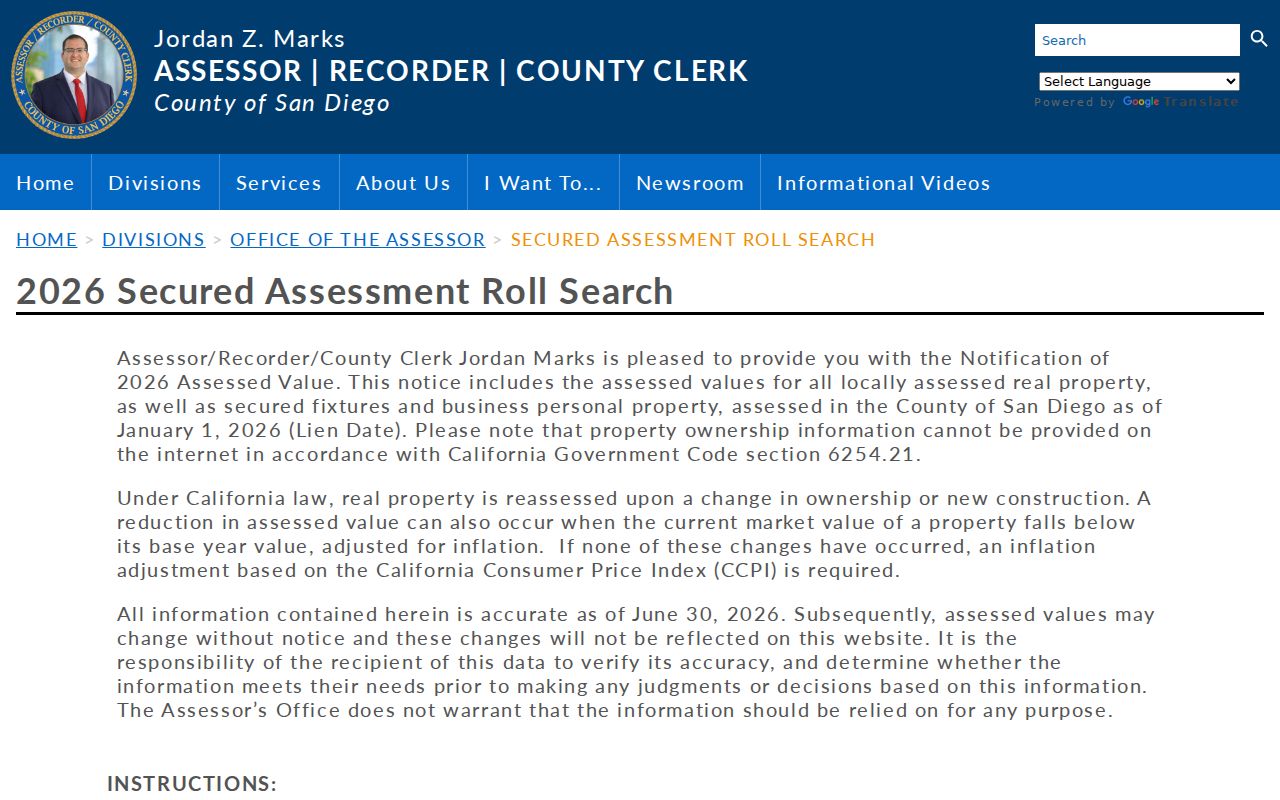
The screenshot's parcel, address, and street-name paths support a repeatable street walk. If the needed name is absent, keep the APN and switch to the county contact route rather than guessing from a tax value.
Note: Owner-name suppression is a search limitation, not evidence that the parcel has no owner record.
Vista GIS for Parcels and Layers
The City of Vista GIS service is useful for walking a street visually. Its public parcel layer exposes the display field SitusAddress, map identify actions, parcel geometry, and relationships to address points. The underlying service documents pan and zoom, distinct and order queries, distance queries, pagination, and a maximum of 2,000 records. The consumer application displayed a username and password gate during research, so public PDF maps, SanGIS, and county map channels remain important fallbacks.
Layers documented for Vista include parcels, site addresses, street centerlines and names, city limits, annexation history, tract and subdivision boundaries, postal ZIP boundaries, schools, parks, election precincts, zoning and land use, flood overlays, water and sanitation districts, contours, and aerial imagery. Those layers explain why a street directory result may cross more than one jurisdiction. They add geography; they do not expose a household roster.
- Situs address
- The mapped location of the parcel or structure.
- Mailing address
- Where tax or agency correspondence is sent. It can be different from the situs.
- Plat
- A recorded map showing lots, blocks, streets, and subdivision geometry.
- Criss-cross directory
- A reverse section arranged by street address rather than only by surname.
Use the Vista 2030 Land Use map when the live GIS gate blocks a street walk. A map can show limits and parcel context, while ARCC remains the source for ownership and title evidence.
Note: The public GIS layer shows situs geography; ARCC remains the source for title evidence.
Vista APNs to Recorder Records
The recorder's party index and the assessor's parcel search are related but not identical. The ARCC Official Records Index reaches from 1970 to the present and shows indexed facts, not the document image. Search by grantor or grantee name, note the document type, recording date, and document number, and then use the image or ordered copy to read the legal description. The APN search change is especially important for a Vista address: since December 9, 2024, ARCC removed APN searching from the online Official Records Search, while office kiosks continue to support it.
ARCC's order route requires an account for copies. The county says orders are printed the next business day and ordinary delivery takes another three to five business days. The 2025 fee schedule lists two dollars for the first page, five cents for each additional page, and one dollar for certification. A public kiosk can be better than the web when a street search begins with an APN.
The recorder index page documents the coverage and access split. The image below captures the county's recorded-document route, where a street clue becomes a party and document trail.
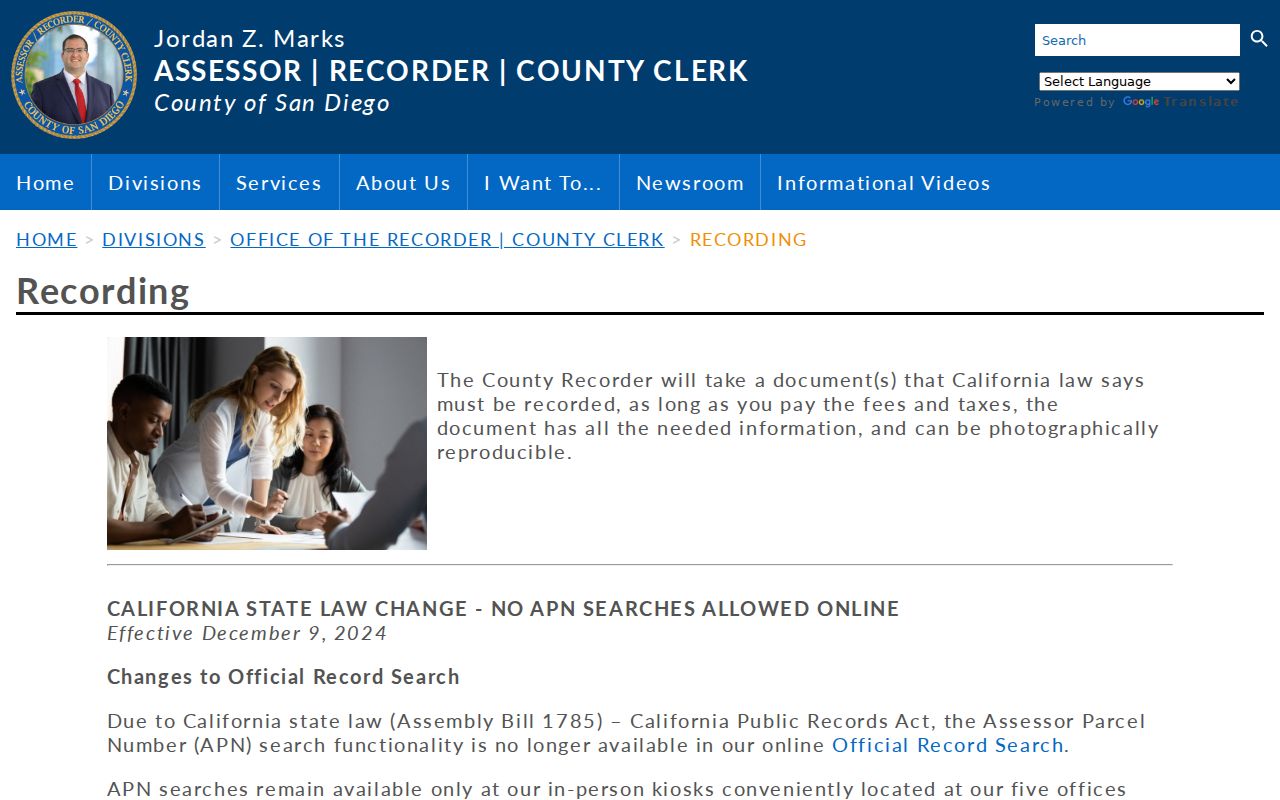
After obtaining a deed, follow the prior-document references and confirm the legal description. A street number can change, while the land description remains the stronger link.
Vista Street Permits Put Dates on Property
Permit files are address evidence with a filing date. A Vista building application can contain a permit or application number, type, project name and value, address, suite, APN, occupancy and construction data, floor area, existing and proposed use, project description, owner, applicant or lessee, and permit-holder details. The record may show who applied or contracted for work, not who lived there. The city says residential blueprints are not retained, so ask for permit history, inspection, final, and planning records instead of promising a plan set.
Use a focused request through the Vista City Clerk public-records channel. Identify the street address, likely department, date range, permit number if known, and desired electronic format. The California Public Records Act requires a determination within ten calendar days in the ordinary case, with a written extension of up to fourteen days for unusual circumstances. Inspection is generally free; copies follow permitted direct-cost rules or a special schedule.
| Permit clue | How to read it in a street directory |
|---|---|
| Owner or applicant | Person or entity connected to the project on the application date. |
| Contractor | Builder or trade contact, not a household conclusion. |
| Issue and final dates | Dates for work or inspection milestones, not a move-in date. |
| APN and address | Keys that help join the file to parcel and title research. |
Note: Permit applicants and contractors describe a project filing, not everyone who occupied the address.
Reverse Directories for Earlier Vista Streets
A criss-cross or reverse directory can turn an address into a listed subscriber or occupant for a particular edition. The result is valuable historical evidence, but it is incomplete by design. Unlisted households, renters, children, and people between editions may not appear. SDCL's Vista branch has local-history and reference material, and its catalog surfaces a North County local-history research guide. Ask staff to search by publisher, regional title, telephone book, yearbook, or reverse directory rather than relying only on the words “Vista directory.”
Regional holdings documented by San Diego repositories include city and county directories from 1886 through 1984 and telephone directories from 1906 onward. The exact Vista-only run was not published online, so a shelf check is required. The 1930 San Diego City and County Directory explicitly includes Vista on its title page. Pair a reverse entry with a deed, census schedule, obituary, or newspaper item before making a claim about who lived at a street address.
Postal Edges Along a Vista Street
A complete postal address is a separate key from a city boundary. Vista uses ZIP Codes 92081, 92083, 92084, and 92085 in the documented research. The USPS operational material grouped 92081 and 92085 under Vista Main in one publication and 92083 and 92084 under Vista Annex in another. Those groupings describe postal operations, not neighborhoods or incorporated limits.
Use the USPS ZIP Code Lookup for a complete address, then compare the result with the city-limit and sphere-of-influence maps. A postal Vista address can sit outside the city, and an edge parcel can carry another postal identity. The research did not locate a stable official street-renumbering history for Vista, so preserve the legal description and old address form when a historical source uses a different name.
Vista Owner Records After Recorded Documents
ARCC Owner Alert is a practical companion to the street directory. It lets a participant enroll a name, email, and optional APN to monitor future recorded documents. The service is free and tied to the county's 1970-present index statement. It does not create a resident list, reveal every past instrument, or prove who occupies the property. It is a forward-looking notice tool.
Use the ARCC Owner Alert page to review the registration fields and limits. The captured page belongs in a street workflow because a person who is researching a parcel can watch for a new recording after the title trail is established.
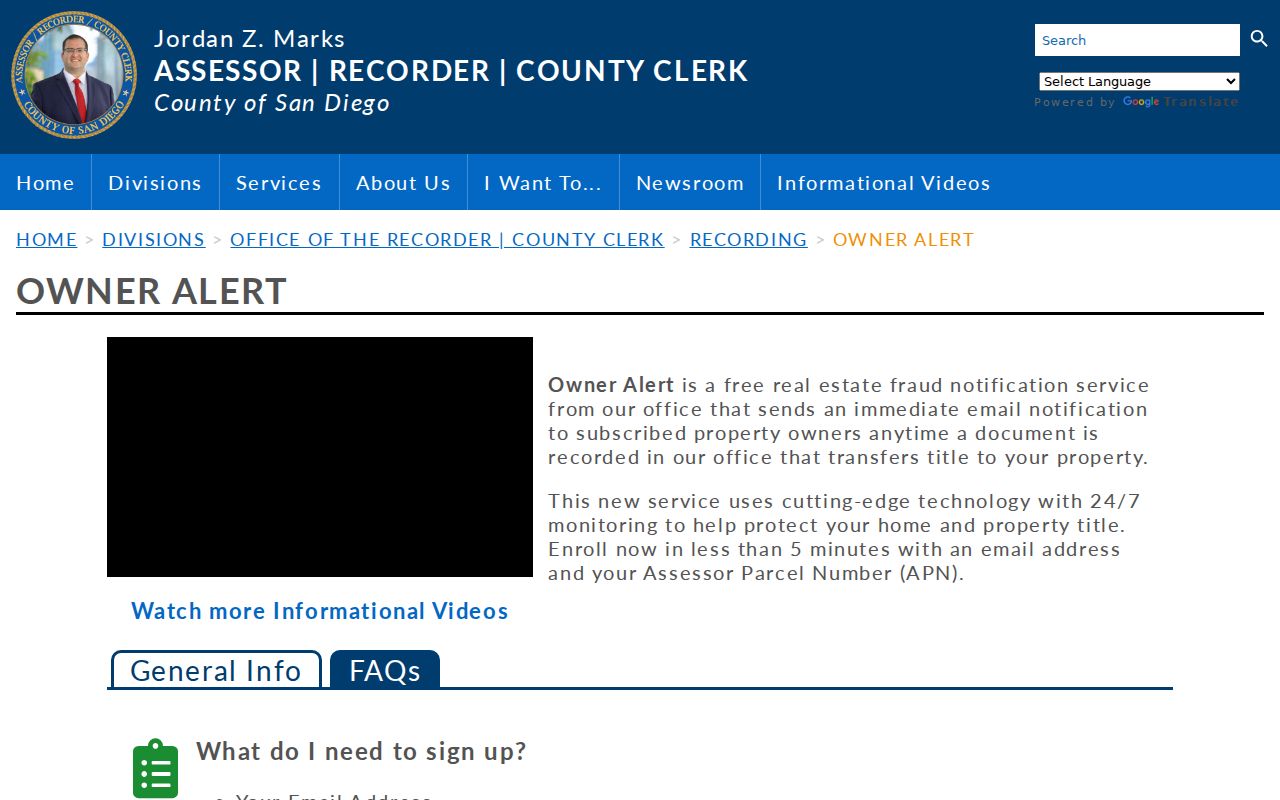
An alert is not a substitute for a certified copy. If a notice arrives, verify the document number in the official index and order or inspect the record before drawing a conclusion.
What the Vista Street Directory Cannot Show
Property and deed records do not systematically index renters, household members, minors, or every person who spends time at an address. Utility-customer records are not a public directory. The federal Driver's Privacy Protection Act restricts motor-vehicle personal information, and California's Safe at Home program protects eligible participants through a substitute mailing address. A legal owner may be a trust or company. A mailing address may belong to an offsite owner, manager, or representative.
Voter information is also not a casual street roll. The state permits limited self-service and approved-purpose file access, while confidential voters, protected addresses, signatures, and key identifiers stay out of the ordinary result. For the one-person question, use the Vista resident lookup workflow rather than turning a street sweep into a name claim.
Lawful use. A Vista street directory is a tool for lawful personal research, family history, civic understanding, and safety awareness. Do not use address records to stalk, harass, threaten, or harm anyone.