
What a Vista Resident Lookup Can Confirm
The first choice is the record that answers the actual question. Ownership is not residency. A court party is not a household member. A license is an occupational credential. A vital certificate confirms an event only under its access rules. This coverage table gives each source a defined role in a Vista resident lookup.
| Record | What it can confirm | Where | Access |
|---|---|---|---|
| Parcel and title | Ownership or recorded property relation | San Diego County ARCC | Assessment web facts; owner route by office; recorder index from 1970 |
| Court case | Party name, role, case dates, events, and disposition as displayed | San Diego Superior Court | Online indexes, clerk, terminal, or copy request |
| Vital certificate | Birth, death, marriage, or divorce event facts | ARCC or CDPH | Authorized or informational copy rules |
| Business or FBN | Entity affiliation, registrant, agent, or filing address | California SOS or ARCC | Basic online search and county request routes |
| Professional license | Credential status, board, published contact, and discipline link | California DCA and boards | Free search; coverage varies by board |
| Directory or census | Past household, occupation, address, or relationship clue | Libraries, NARA, archives | Edition, year, geography, and omission limits |
Use more than one row when identity matters. A parcel can anchor a person to land, a docket can supply a role and date, and a directory can connect an older address to an occupation. The combined chronology is stronger than any isolated hit.
Note: A source can confirm a dated role or event without confirming current residence at an address.
Vista Lookup Needs More Than a Name
Same-name errors are the central risk in a resident lookup. Compare a middle name or initial, last name at birth, spouse or associate, county, party role, filing date, parcel legal description, business entity number, license number, or case number. A phone call to an office can explain the access route, but staff generally will not disclose protected facts just to settle a hunch.
Chronology is a useful filter. A person appearing in a 1930 directory cannot be assumed to be the same adult in a current business filing. A deed party can be a trust or company. An obituary may describe an earlier address. A court case can list a business name or a role that says nothing about residence. Write down what the record says and what it does not say.
- Docket
- The court's running record of a case, including filings, events, and dates.
- Index versus image
- An index points to a record. The image or file contains the full instrument or pleading when access is allowed.
- Certified copy
- A copy authenticated by the custodian. It has a different purpose and fee from a free index view.
- Disposition
- The recorded outcome or status of a case event. It is not automatically a finding about a person's character.
Vista Court Lookup in Practice
The San Diego Superior Court is the custodian for Vista trial-court matters. The North County Regional Center at 325 South Melrose Drive houses civil, probate, family, criminal, adoption, and traffic channels. Online services are separate rather than one statewide California name database. The civil party search commonly offers last name or business name, first name, case number, case location, and date limits.
| Search field | What to enter or expect |
|---|---|
| Last Name / Business Name | Required for the party path. Try indexed spelling and a full entity name. |
| First Name | Optional. It can narrow a common name but may exclude initials. |
| Case Number | Required only for the case-number path; use the court's format. |
| Case Location | Conditional site selection, including North County when appropriate. |
| Search / Submit | Runs the selected lookup. New Search or Back returns to the criteria. |
A sample civil detail can show case title, case number, case location, case type, filed date, category and code, party tables, primary-party marker, image status, and microfilm location, reel, and frame. A case detail for City of Vista v. All Person Interested..., case N59840, is a field example rather than a resident record.
The California Courts case lookup guide explains the county-custodian rule and remote-access limits. Juvenile, adoption, sealed, and sensitive family records may be unavailable online even when a courthouse channel exists.
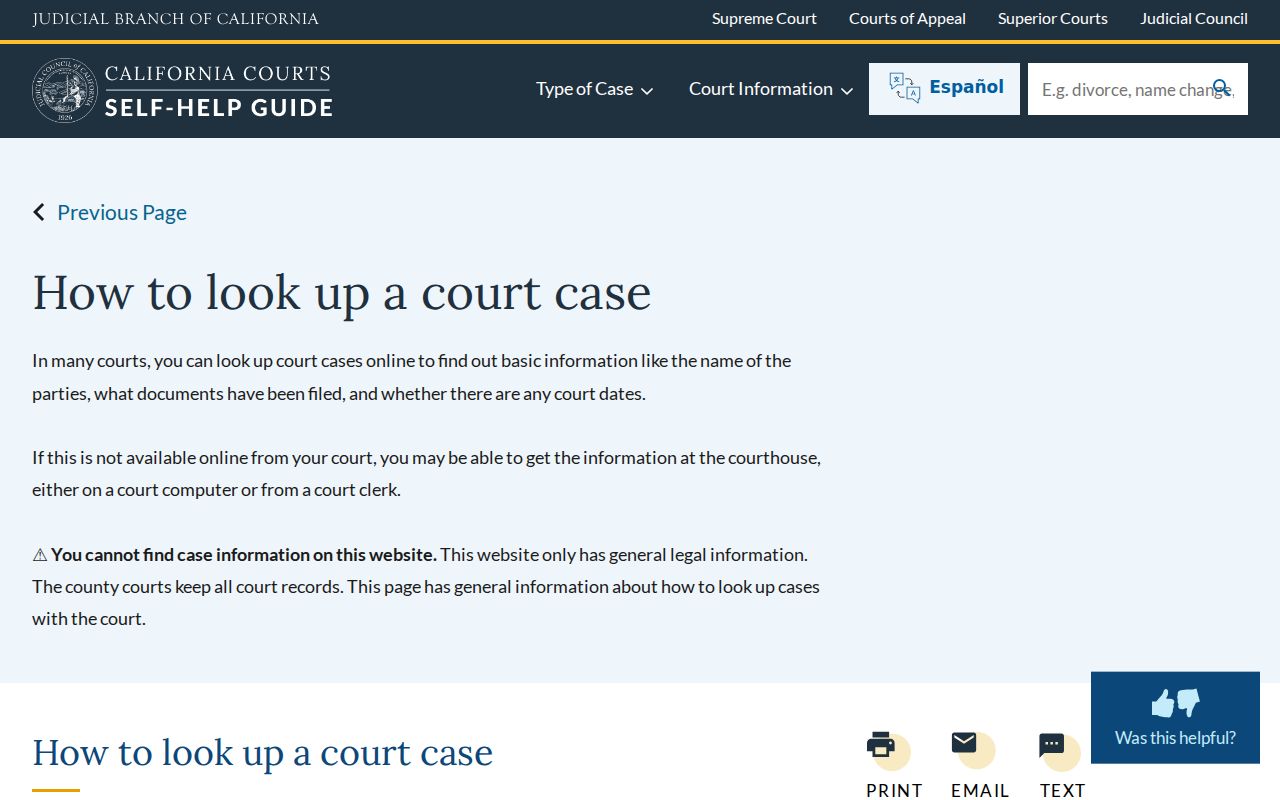
The captured court guidance supports a careful result reading: an online match is a finding aid, and the clerk or terminal may be needed for a register of actions or specific filing.
Note: Keep the case number and party role with every court result to separate similar names.
Vista Court Records and Copies
When a San Diego case index matches, keep the case number, location, party role, and filing date. Ask the North County clerk for the register of actions or a specific filing rather than requesting an undefined file. The courthouse, mail request, and public terminal are separate access channels. Federal cases are a different trail through PACER and the Southern District of California.
California's general copy guidance lists fifty cents per page for ordinary copies, forty dollars for certification, and a fifteen dollar search fee when locating a record takes more than ten minutes. San Diego's current schedule controls the actual charge. Remote access can omit parties or images, and confidential or sealed records remain restricted.
The court copy guide shows the distinction between viewing an index, requesting a paper or electronic copy, and asking for certification. A copy proves what the custodian issued; it does not settle an identity question by itself.
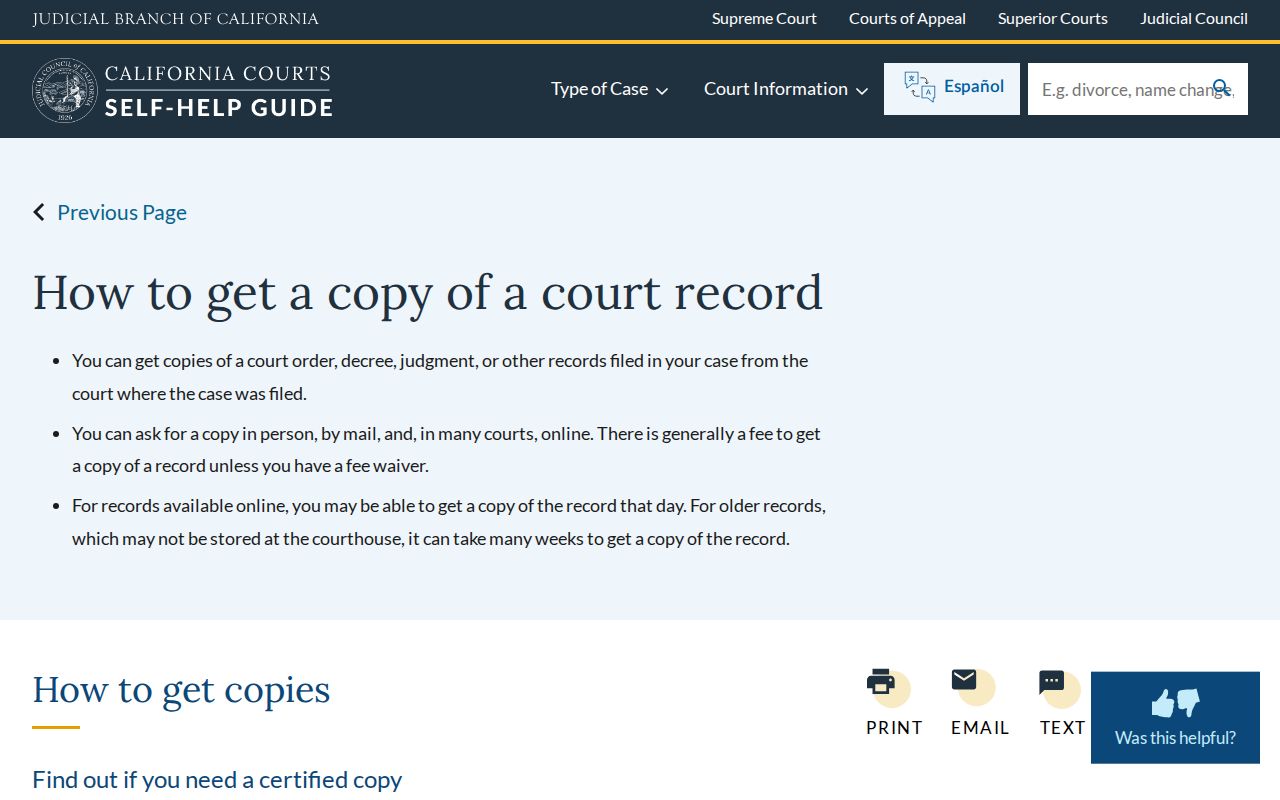
Use the copy route when the exact filing matters. Keep the case number and page count with the result, and compare the party's role and date with the other records in the lookup.
Vista Vital Records Have Two Tracks
California distinguishes authorized certified copies from informational certified copies under Health and Safety Code sections 103525 and 103526. An authorized copy requires a permitted relationship and sworn statement. An informational copy is marked as not valid to establish identity. Confidential marriage records are generally limited to a spouse or court-authorized requester under Family Code section 509. Adoption and original birth records are sealed.
| Event | Vista custodian and route |
|---|---|
| Birth | San Diego ARCC or CDPH. Use the copy type and relationship rules for the request. |
| Death | ARCC or CDPH. A state failed search can produce a Certificate of No Public Record while retaining the search fee. |
| Public marriage | ARCC or CDPH. Provide both parties, county, and event date where known. |
| Divorce | Superior Court holds pleadings and decree; CDPH VS 113B is a certificate of record for qualifying years. |
The CDPH vital-record forms page lists VS 111 for birth, VS 112 for death, VS 113A for marriage, and VS 113B for divorce. The CDPH vital-records overview explains the state issuance path. Forms ask for the applicant and mailing details, event subject, date and place, parents or spouses when relevant, relationship or eligibility, signature, and payment. Mailed authorized-copy requests can require a sworn statement and notarization.
County and state fees differ. Research notes list county schedule amounts of thirty-two dollars for birth, twenty-four for death, and seventeen for marriage under the 2025 schedule; the CDPH 2026 fee schedule lists thirty-one, twenty-six, nineteen, and eighteen for the listed certificate types. Verify the checkout total and custodian before sending a payment.
Note: County and state vital-record fees differ, so verify the custodian and total before mailing an application.
Vista Property Records and Residency
The San Diego County assessor search can locate a parcel by address, street name, or APN, but the internet result suppresses owner names. ARCC's recorder index covers 1970 to the present and supplies party and instrument information, not a household roll. Ownership or a mailing address can be a strong lead for a Vista resident lookup, yet a property may be owned by an entity, trust, offsite person, or estate.
Use phone and office channels when the web result is missing the needed name. The recorder offers kiosk image access, and APN searching moved to county kiosks in December 2024. The County Archives, library directories, census schedules, permits, and newspapers help with an older address. For a full address chain, switch to the Vista street directory workflow.
Vista Voter Records Use Authentication
California VoterStatus lets an individual review personal registration and election information after authentication. It is not a public resident lookup by name, street, or ZIP. Voter-registration information is restricted under Elections Code sections 2188, 2194, and 18109. An approved-purpose request can include names, dates of birth, registration dates, residence and mailing addresses, precinct, contact information, and party preference, while optional history shows election method but never ballot choice.
Full-file requests can be statewide or limited to up to ten specific voters, with a one-hundred-dollar statewide fee or thirty dollars per specific record capped at one hundred dollars. SOS describes seven to fourteen business days for review. The form requires an applicant, purpose category, project statement, identifiers, security acknowledgments, and signature under penalty of perjury. Confidential voters, preregistered minors, signatures, driver-license data, and Social Security data are excluded.
The California VoterStatus form should be used for the person being authenticated. It is not a shortcut around the approved-purpose rules.
Vista Business Records and Licenses
Business and professional sources can test a name without claiming that a work address is a home. California Secretary of State bizfile Online searches an entity name or number and can show status, formation date, jurisdiction, street or mailing address, agent, filing history, and reported officers or managers where filed. Bizfile requires at least three characters for a basic name search and supports advanced starts-with, status, type, group, and filing-date filters.
The Department of Consumer Affairs search spans participating boards and can return license type, number, status, issue or expiration, publishable address, and discipline links. San Diego FBN records add local fictitious-name registrants and dates. Compare entity numbers, filing dates, board details, and county records instead of treating a single business match as residence proof.
The California business search capture shows the state entity path.
Entity results are strongest for affiliation and chronology. The business search itself warns against treating SOS as a complete ownership registry.
The California DCA license search provides a separate credential path.
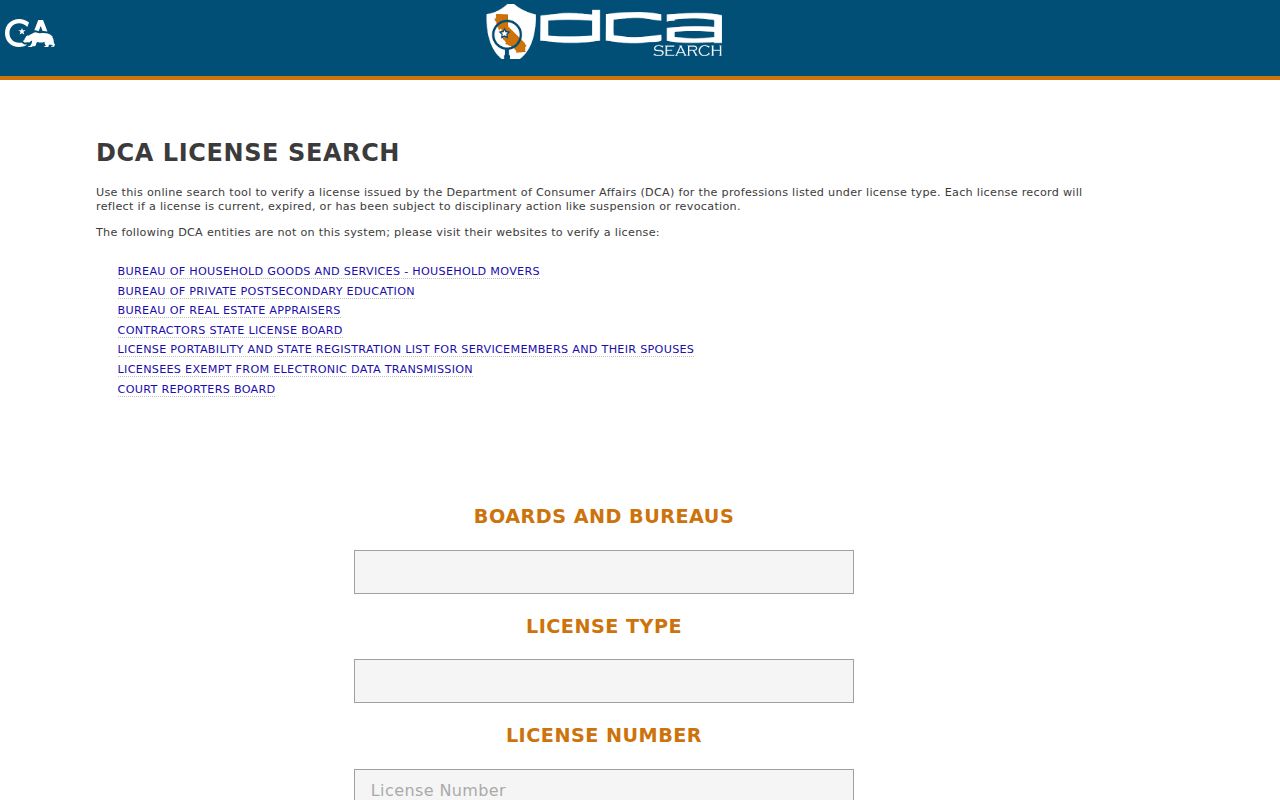
A license result can confirm status or discipline information published by a board. It does not establish a current household or private address.
Vista Resident Lookup for Family Connections
Some resident lookup goals have a lawful specialist route. Probate petitions and notices can identify heirs when a case is public. Obituaries and the Vista Press can connect relatives and former addresses. Former classmates may appear in yearbooks held by the library or archives. California's CDSS Post Permanency Services uses consent-based forms such as AD 902 and AD 904A/B for adoptee and birth-relative contact. Original birth-record access follows a petition or unsealing process, not an ordinary directory search.
- Anchor the name. Start with an address, date, county, middle initial, or role from a lawful property, directory, business, or court clue.
- Check the local index. Search the San Diego court party route or ARCC record channel using the spelling and date range that fit the clue.
- Confirm the event. Use the vital-record custodian, probate file, obituary, or archive when the question concerns a birth, death, marriage, or family relationship.
- Compare affiliations. Test a matching entity number, license, FBN filing, or directory occupation without treating a work address as a home.
- Save the limits. Keep the source, date, record role, and unresolved conflicts with the result.
For a deceased person, start with a dated death or obituary clue, then look for probate, property transfers, cemetery or newspaper evidence. For a classmate, use the school year and edition before a surname search. For a business principal, compare the SOS entity and county FBN filing. Libraries and FamilySearch catalogs can supply microfilm or derivative indexes, but an original custodian record is preferred when the relationship matters.
If a city-created record is not online, file a narrow California Public Records Act request with the City Clerk. The ordinary determination period is ten calendar days, with a written extension of up to fourteen days for unusual circumstances. Ask for an existing record by address, department, type, and date, not for a new list of people.
Note: Consent-based family contact routes are different from an open directory search and require their own forms.
The Lawful Boundary of a Vista Resident Lookup
California Safe at Home provides a substitute mailing address and protected handling for eligible survivors and other participants. For a custody-related status question, the CDCR incarcerated-person locator is a state-specific search with its own disclaimer, not a Vista resident directory. Voter confidentiality rules, sealed court categories, vital-copy eligibility, and the federal Driver's Privacy Protection Act create additional limits. A person absent from a public result may be protected, unlisted, outside the edition's geography, or simply missing from that index.
Use a Vista resident lookup for lawful personal research, family history, reconnecting, civic understanding, or a defined records question. Confirm important facts with the custodian and keep the record date. A commercial compiled result can contain stale addresses or merged identities, so it is a lead at most, not official proof.
Lawful use. Never use a resident lookup to stalk, harass, threaten, intimidate, or harm another person. Public access to a record does not create permission to misuse it.