
Finding People in the Vista Residents Directory
Vista is its own city. But the records that tie a person to the community sit in many hands. The City Clerk holds what Vista created. San Diego County's Assessor/Recorder/County Clerk keeps the property side. The Superior Court, state agencies, libraries, and archives hold the rest. An address makes a strong first clue. It can open a parcel, an assessment notice, a recorded instrument, and a dated permit. A name works differently. It points to a court party, a business filing, a professional license, or a historical entry. A date shifts which source fits best.
Each record proves something narrow. A deed names the parties to a transfer, not the whole household. An assessment notice gives parcel facts while the county withholds owner names online. A voter record is not a public name list. City directories and newspaper items carry real historical weight. Yet they can skip people or repeat a stale address. A careful Vista residents directory search keeps track of what each source actually shows.
- Start with the clue. Use the address for a parcel trail, the name for a court or affiliation search, and the year for a directory, census, newspaper, or archive search.
- Place the clue in the right office. Use the San Diego County assessment roll for parcel facts and ARCC recorded documents for deeds.
- Separate current from historical evidence. California VoterStatus authenticates one voter; the library and archives are better routes for older households and past addresses.
- Check a second identifier. Compare a middle initial, party role, parcel legal description, spouse, date, entity number, or occupation before joining two records.
- Use the fallback channel. Ask the custodian, courthouse clerk, archive, or library for the item when the online index stops, omits a category, or hides the needed field.
Note: A blank online result only means the index holds no match for that name or address, not that no record exists.
Where Vista Resident Records Live
These offices make up the working map behind a Vista residents directory. San Diego County ARCC folds assessor, recorder, and county-clerk duties into one agency. But each division answers a different question. The Superior Court stands apart from ARCC. Both are county custodians, yet their files do not overlap. The City Clerk keeps Vista-created records under the California Public Records Act. State agencies run statewide registrations and protected-address programs.
ARCC Recorder / County Clerk
Deeds, liens, maps, birth, death, marriage, FBN, and county-clerk records.
Recorder 619-238-8158
General 619-237-0502
San Diego County Assessor
Parcel numbers, assessment years, land and improvement values, exemptions, and taxable values.
Public Information 619-236-3771
North County Regional Center
San Diego Superior Court civil, probate, family, criminal, traffic, and other case channels.
325 South Melrose Drive, Vista
760-201-8600
Vista Library and Archives
Local history, directories, newspapers, yearbooks, census help, and older county record series.
Reference access varies by collection and license.
Phone and counter staff can explain the lawful route, though no phone call opens a restricted record. For anything the city itself created, the Vista public-records request route is the right fallback. Narrow the request by department, address, record type, and date so the clerk can find an existing file.
Vista Assessment Records Hide Owners Online
One quirk shapes nearly every Vista property search. The San Diego County secured assessment roll lets anyone search online by parcel number, street address, or street name. It returns solid assessment facts. But California Government Code section 6254.21 blocks owner names from the web result. So a match can confirm the parcel and its assessed values. It does not name the person on title. Ownership questions have to move to a lawful office, phone, vendor, or kiosk channel instead.
| Search field | What the Vista search accepts |
|---|---|
| Parcel Number | Full hyphenated format such as 123-456-78-90, or at least eight digits such as 123-456-78. |
| Address | Street number and street name. Use one search mode at a time. |
| Street Name | Supports a street-oriented assessment search for parcels sharing a street name. |
| Search | Runs the selected mode and returns a matched annual assessment notice. |
| Print control appears on the assessment notice. |
A matched assessment notice packs in plenty of useful detail. Expect the APN, the assessment year, and the January 1 lien date. It also lists separate land and improvement values. Those combine into a total assessed value. Exemptions and taxable value appear too. When a value changed for a special reason, a factored base-year value may show up. The roll is stated as accurate through June 30 of the roll year. None of this counts as title evidence just because a parcel search returned a hit.
For a Vista residents directory, that distinction matters. A parcel is a bridge, not a person. The assessor's mailing addressee could be an accountant, a trust, or an heir. Call Assessor Public Information to confirm the lawful ownership or address channel. Then carry the exact name and legal description into the recorder index. Never read a tax addressee or parcel owner as proof that someone lives there now.
The official assessor search page displays the secured roll interface. It offers address and street-name paths plus the notice restricting owner-name queries. Expect an incomplete web result there rather than a failed search. For the recorded-document and county-clerk routes, there is the ARCC Recorder and County Clerk page. It identifies the office that handles them.
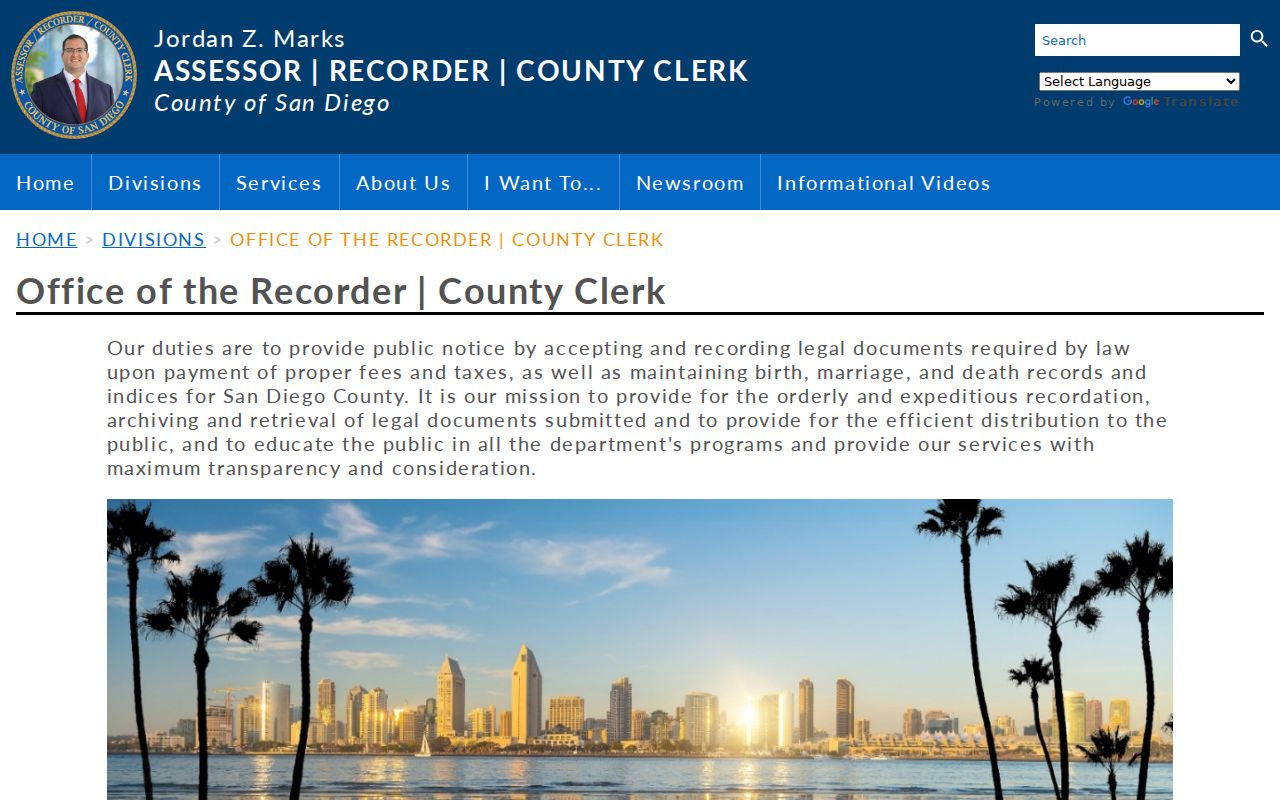
The ARCC page links the assessment result to county contact routes. A name withheld from the web may still be reachable through a counter or another documented channel, subject to the law governing the request.
Note: Online assessment facts can pin down a parcel even while the owner's name stays off the web result.
From a Vista Parcel to a Recorded Deed
A Vista address on the assessment roll is only the first half of the story. The recorder's side supplies the title trail. San Diego County's online Official Records Index reaches back to 1970. It shows indexed entries rather than document images. Search by party, choosing grantor or grantee. Then capture the document number, recording date, document type, and any book or page reference. Copies can be ordered, or images viewed at a public kiosk.
Keep the tool in perspective. A recorder party connects to an instrument, not to a full Vista residents directory.
Working backward, the chain reads like this: address to APN, APN to a lawful owner channel, owner to vesting deed, deed to prior grantor, and so on. It sounds simple. It breaks easily. Rely on the legal description as the control. Common names, trusts, entities, and refinancing paperwork all invite false joins when a street address carries the whole load.
- Parcel
- A tax-defined piece of land identified by an APN. One parcel can have several structures or units.
- Index
- A finding aid with names and placement fields. It is not the same as the recorded image.
- Grantor and grantee
- The grantor transfers an interest; the grantee receives it. The roles help order a deed chain.
- Legal description
- The subdivision, lot, block, or metes-and-bounds language that anchors the instrument to land.
Ordering copies through ARCC takes an account. The office prints orders the next business day. Ordinary mail adds three to five business days after that. Under the 2025 fee schedule, a recorded copy costs two dollars for the first page. Five cents covers each additional page, with certification at one dollar. Kiosks at county offices offer image viewing. One catch matters: since December 9, 2024, APN searching works only at ARCC office kiosks. An address-to-APN search in Vista can therefore end at the counter. Even so, the web index itself is free.
Current Vista Resident Sources
Coverage varies widely among current sources. The table lays out who appears in each record, which office holds it, and what level of access a Vista residents directory searcher should expect. That candor keeps a lookup honest from the start.
| Source | What It Can Show | Custodian | Access |
|---|---|---|---|
| Secured assessment roll | Parcel and assessed-value facts | San Diego County Assessor | Free web search; owner names suppressed online |
| Recorded-documents index | Parties to deeds, liens, releases, and maps | ARCC Recorder | Free index from 1970; image by kiosk or order |
| VoterStatus | One voter's own registration and election information | California Secretary of State | Authenticated self-service, not a public directory |
| Court indexes | Case parties, roles, dates, and events as permitted | San Diego Superior Court | Online finding aids plus clerk and terminal routes |
| Business and license files | Entity, registrant, agent, or credential affiliation | California SOS, ARCC, DCA | Free basic searches; field and copy rules vary |
Every official roll has limits. Read them alongside any result. A court case names a party but proves nothing about where that person lives. A business agent may simply list a registered office. A license address might serve as a professional contact point. A city permit names an applicant or contractor tied to one project date. Treat each as one piece of a resident lookup, never a substitute for verification.
| Official source | Compiled commercial data |
|---|---|
| Named custodian, stated coverage, and access rules | Mixed sources and unclear update timing |
| Useful for a dated record question | May merge people with similar names |
| Correction or copy route is defined by the office | Removal and correction steps vary by provider |
Vista Voter Records Actually Permit
California VoterStatus works as an authenticated self-check, and that is its design. The Secretary of State's voter-status form is not a name-and-address directory for browsing Vista residents. Elections Code sections 2188 and 2194 restrict the full voter file. Section 18109 makes unlawful acquisition or use a potential misdemeanor. Political, governmental, scholarly, journalistic, and election purposes can qualify through the statutory request process.
Each approved application covers up to ten specific voters. The statewide file carries a one hundred dollar fee. A specific-voter request costs thirty dollars per record, capped at one hundred dollars. SOS quotes a review period of seven to fourteen business days. Approved files may include names, birth dates, and registration dates. They may also include residence and mailing addresses, precinct, contact information, and party preference. Optional history records show the election date, type, and voting method, never how someone voted. Confidential voters, preregistered minors, signatures, driver-license numbers, and Social Security data stay excluded.
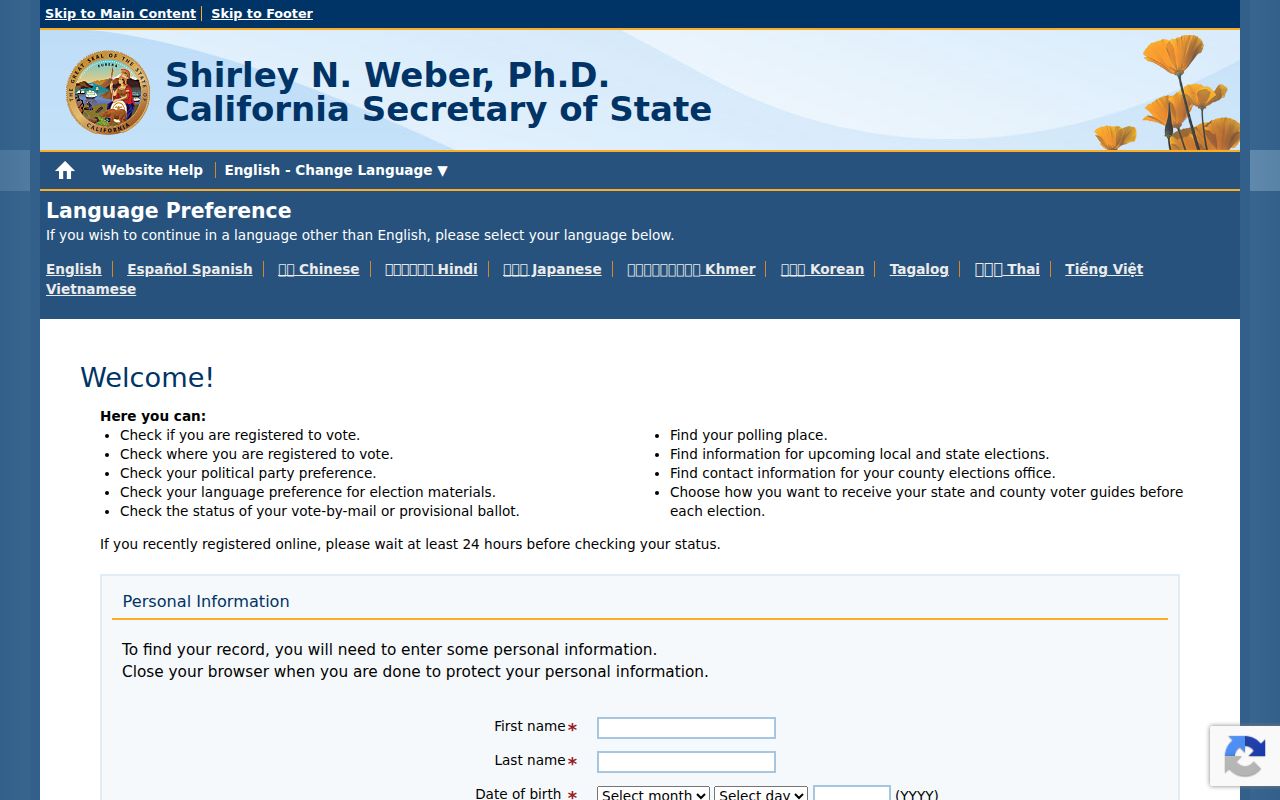
The VoterStatus page shows this personal-authentication model in practice. A lawful project needing voter data should use the state request form with its permitted-purpose statement. For family, neighborhood, or historical research in Vista, public property, court, directory, newspaper, and archive sources serve far better.
Vista Vital Records Follow Different Trails
Vital records do not sit in one open index. San Diego County ARCC issues county birth, death, and marriage certificates. The California Department of Public Health holds statewide registrations. It also distributes forms for birth, death, marriage, and divorce certificates. A divorce decree or pleading lives with the Superior Court. CDPH's VS 113B is a certificate of record for qualifying years. It is not the court file itself.
| Record | Vista access route |
|---|---|
| Birth | ARCC or CDPH. Authorized copies require eligibility and a sworn statement; informational copies carry a limitation. |
| Death | ARCC or CDPH. County and state fees differ, and a failed state search retains its search fee. |
| Public marriage | ARCC or CDPH, with party and event details used to distinguish the record. |
| Confidential marriage | Generally limited to a spouse or court-authorized requester under Family Code section 509. |
| Divorce | Superior Court holds the decree and file; CDPH may issue a certificate of record for its covered period. |
State law splits certified copies into two tracks. The governing rules sit under Health and Safety Code sections 103525 and 103526. Authorized copies demand a permitted relationship and a sworn statement. Informational copies carry a mark stating they cannot establish identity. No fixed rule opens every modern birth or death record. None becomes public after a set span of years. Historical indexes, cemetery records, newspapers, and FamilySearch collections each follow their own coverage instead.
The Vista Courthouse Records Route
The North County Regional Center at 325 South Melrose Drive is a full-service branch of the San Diego Superior Court. Its dockets run civil, probate, family, criminal, adoption, traffic, and minor-offense channels, each separate from the rest. The main business line is 760-201-8600, with civil at extension 150, criminal 160, family 140, adoption 1410, and traffic at 760-201-8500. Many lines answer only from 8:30 to 11:30 a.m. on weekdays, so confirm counter hours before traveling.
Online, the county's civil party search accepts a last name or business name, first name, case number, case location, and date limits. A result can show the case title, number, location, type, filing date, category, party roles, image status, and microfilm placement. The California Courts lookup guidance explains why the county remains the custodian and why a courthouse terminal can display more than remote access. For the Vista location and division routing, the North County Regional Center listing has the details.
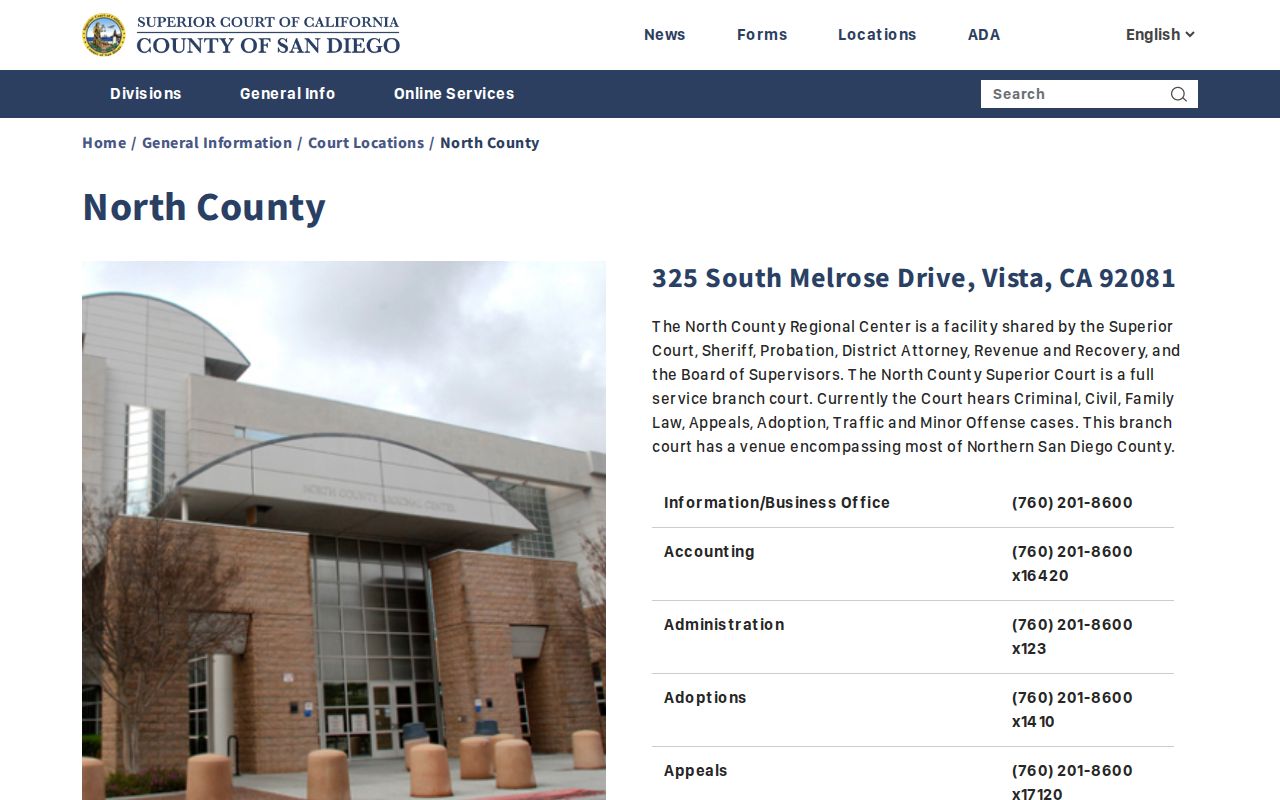
A Vista courthouse search has two sides. The online index is only one of them. Sealed files, juvenile matters, adoptions, and other restricted categories never appear in remote displays. Family or criminal case details can stay thin from home. That is when the physical records channel matters. A clerk at the Vista courthouse can pull a register of actions or copy specific filings by case number. Charges fall under the current local fee schedule. California's general copy guide sets fifty cents per page. Certification costs forty dollars. A fifteen dollar search fee applies once a clerk spends more than ten minutes on a lookup. Ask the county to confirm its charge before you order anything.
Note: A Superior Court party search works as a finding aid. Confidential case categories may stay unavailable remotely.
Vista Business and License Records
A Vista business record can pin down a person faster than a name search. The California Secretary of State's bizfile Online returns an entity number, status, formation date, jurisdiction, addresses, agent, and filing history. It also reports officers, directors, members, or managers where filings list them. It is not a full ownership registry. San Diego Fictitious Business Name filings cover local assumed names and their registrants. A business mailing address proves nothing about where anyone sleeps.
Two state tools extend the lookup. The Department of Consumer Affairs search shows license type, number, status, issue and expiration dates, and publishable address. It also links to discipline records for participating boards. The State Controller's unclaimed-property search lists a reported owner, city, holder, and property type. That listing appears before any claim is filed. Treat every hit as an affiliation or location clue. Compare entity numbers, dates, and county records before drawing conclusions. A business listing is not a statement about a household.
Vista's Library and Historical Shelf
The Vista branch of the San Diego County Library doubles as a desk. It works as an offline residents directory for the city. SDCL's collection policy flags Vista as a branch holding a large reference collection. That collection generally must be used in the building. Its catalog surfaces Research Guide to Local History: North County San Diego. Ask staff for city directories, suburban directories, reverse directories, and telephone books. Also ask for yearbooks, obituary databases, newspapers, and vertical files. Request them by title or publisher. A catalog record may never use the phrase "Vista city directory," so search broadly.
Regional archives fill the missing years. San Diego History Center material documents an 1874 business directory. It also documents an 1886-87 San Diego City and County Directory. The 1930 directory scan lists Vista among its covered towns and post offices. The Vista Press archive runs annually from 1926 through 1973. Its advertisements, society columns, legal notices, and obituaries can bridge a gap between directory editions. One caution applies: the History Center's current notice says in-person resources are unavailable until further notice. Use its virtual collections or email route before you plan a visit.
Printed entries demand interpretation. A business-classified item may name an institution, a corner, a proprietor, a cashier, or a rate. It gives no home address. A later alphabetical or reverse volume may add occupation, spouse, and residence. It may also carry an owner or renter symbol. Check those fields against the abbreviation key in the actual volume before trusting them.
Vista's Web Records Stop at 1970
The recorder's online index stops at 1970. That cutoff is not the start of San Diego County records. When a Vista property search hits the wall, save every clue you have. Note the last known name, recording date, subdivision, lot, block, book, page, and any legal description. Take those details to ARCC staff, a public kiosk, or the County Archives. Do not assume an earlier deed never existed.
The County Archives reading room sits at 10144 Mission Gorge Road in Santee. Reach it at 619-237-0502 or archives@sdcounty.ca.gov. Its documented holdings are deep. Deeds run from 1846 to 1918. Homesteads run from 1860 to 1931. Torrens material runs from 1919 to 1955. Patents and title registers run from 1850 to 1930, alongside other specialized series. Past residents of Vista surface through this fallback chain: county archives, the State Archives, FamilySearch catalogs, and the library shelf. Census schedules through 1950 and newspapers help too.
The California Public Records Act offers one more route to an identifiable existing record. The normal determination window is ten calendar days. A written extension of up to fourteen days is possible for unusual circumstances. Inspection is generally free, and copying charges must follow the law or a special schedule. The California Secretary of State CPRA guidance explains the determination and copy principles in plain terms.
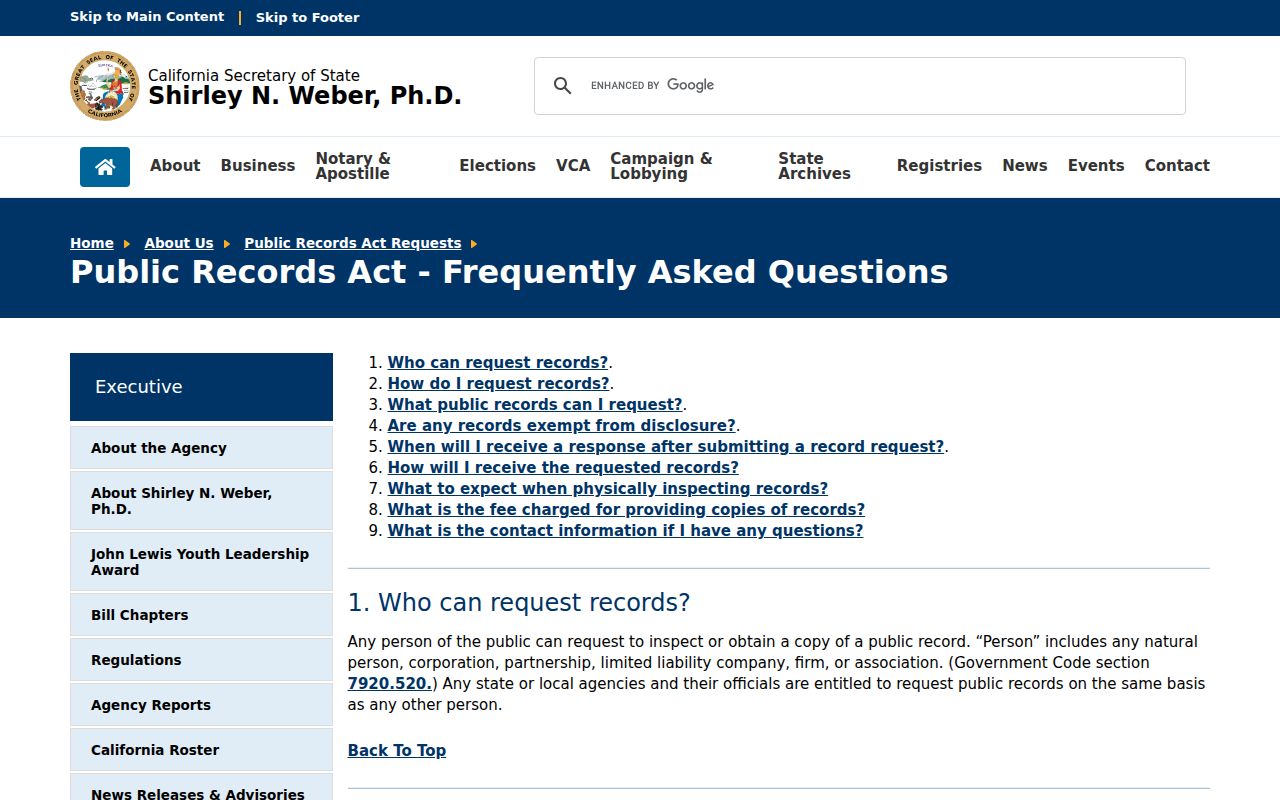
State guidance draws a clean line for records requests in Vista. You may ask for a record that already exists. You may not demand that an agency build a new residents directory for you. Describe the record with a date range, address, department, or identifier. The request then has somewhere to land.
Note: The recorder's 1970 cutoff marks online coverage. It is not the beginning of San Diego County's recorded history.
Vista Resident Lookup Needs More Than a Name
A name match is only the start. Every Vista resident lookup needs a second clue to confirm the person. Try a middle initial, a party role, or a filing date. Consider a spouse, an associate, an entity number, a license, a case number, a parcel description, or an occupation. A court docket separates same-named parties through its case number, filing date, attorney, and role. It also weighs any related property or probate facts. A disappearance from a directory can mean many things. It might signal a move, an omission, a death, a boundary change, or simply a gap in publication.
California privacy rules make that second clue matter even more. Safe at Home participants may use a substitute mailing address. Protected voter addresses stay closed to casual browsing. The California DOJ Megan's Law site is a statutory public registry carrying its own use warning. It is not a general residents directory. You can search it by name or map. Yet absence from that registry says nothing about a person's presence in ordinary records.
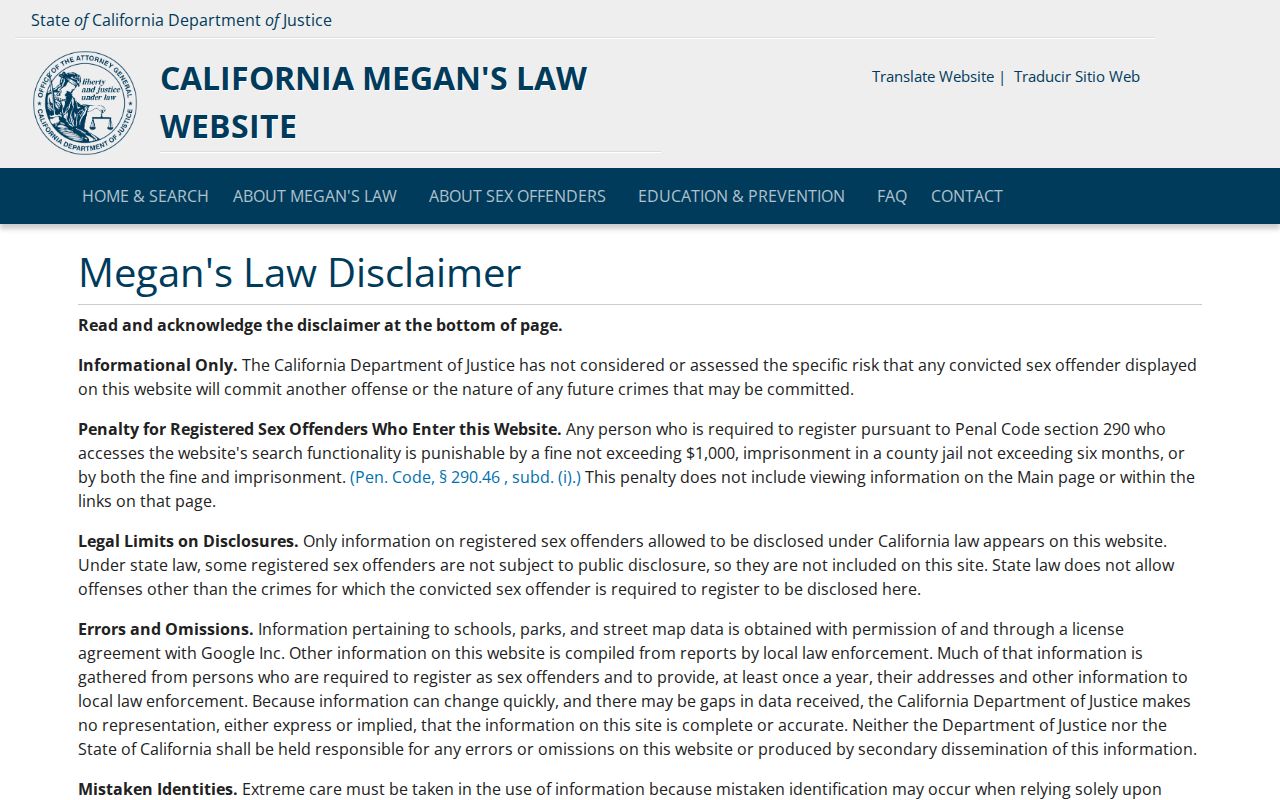
That registry belongs beside its warning. Treat each specialized lookup as a defined record set. Use it only for the purpose its custodian allows, and never turn a public result into a private conclusion about a person.
Lawful use. Vista records are available for lawful personal, family-history, civic, and safety research. Do not use a lookup to stalk, harass, threaten, or harm anyone, and verify consequential facts with the custodian.
Vista ZIP Records Are Not City Lines
Vista has an irregular incorporated boundary. It borders Oceanside, Carlsbad, and San Marcos. ZIP Codes route mail; they do not draw municipal lines. The four documented postal codes are 92081, 92083, 92084, and 92085, with 92085 serving as a PO Box ZIP. Run any complete address through the USPS ZIP Code Lookup, then compare the result against Vista's city-limit and sphere-of-influence maps.
The distinction matters for records. A postal Vista address may sit outside the incorporated city, while a parcel at the city edge can carry a different postal identity. The Mar Vista planning trail records a 2024-25 transition covering 108 parcels and roughly 143 acres formerly under county A70 zoning. Older permits or zoning files may still rest with the county. Later city records then follow a new jurisdiction path.
Earlier Vista Directory Households
The historical side of a Vista residents directory begins before cityhood. Vista became a city on January 28, 1963. The town's post office name dates to 1882. The Vista Land Company laid out the town in 1886. Earlier residents therefore appear in county or town directories, postal records, and newspapers. They also turn up in agricultural and irrigation records, church and school material, and census schedules rather than city minutes.
The strongest directory anchor is the 1930 San Diego City and County Directory. Its title page explicitly includes Vista. Regional holdings described by the San Diego Public Library California Room run from 1886 through 1984. Telephone directories there run from 1906 onward. Each volume's coverage still needs checking. For a fuller historical treatment, see the Vista city directory collections page. A street-by-street address chain belongs in Vista street records.
The Vista Press archive from 1926-1973 connects directory entries to family links, property notices, and advertisements. It also carries obituaries. Dates matter. A newspaper shows a person appearing in a community story. A deed or certified vital record supplies the legal event itself. Read them together, and the past residents of Vista take shape.
Vista Privacy Records and DROP
California's Delete Request and Opt-out Platform is called DROP. It lets a resident send one encrypted request to more than 500 registered data brokers. The California Privacy Protection Agency adopted the rules in 2025. Broker processing begins August 1, 2026 under the documented rollout. DROP targets compiled commercial data. It does not erase a deed, court file, assessment record, or lawful copy held by a government custodian. The California DROP rules page carries the program's rollout details.
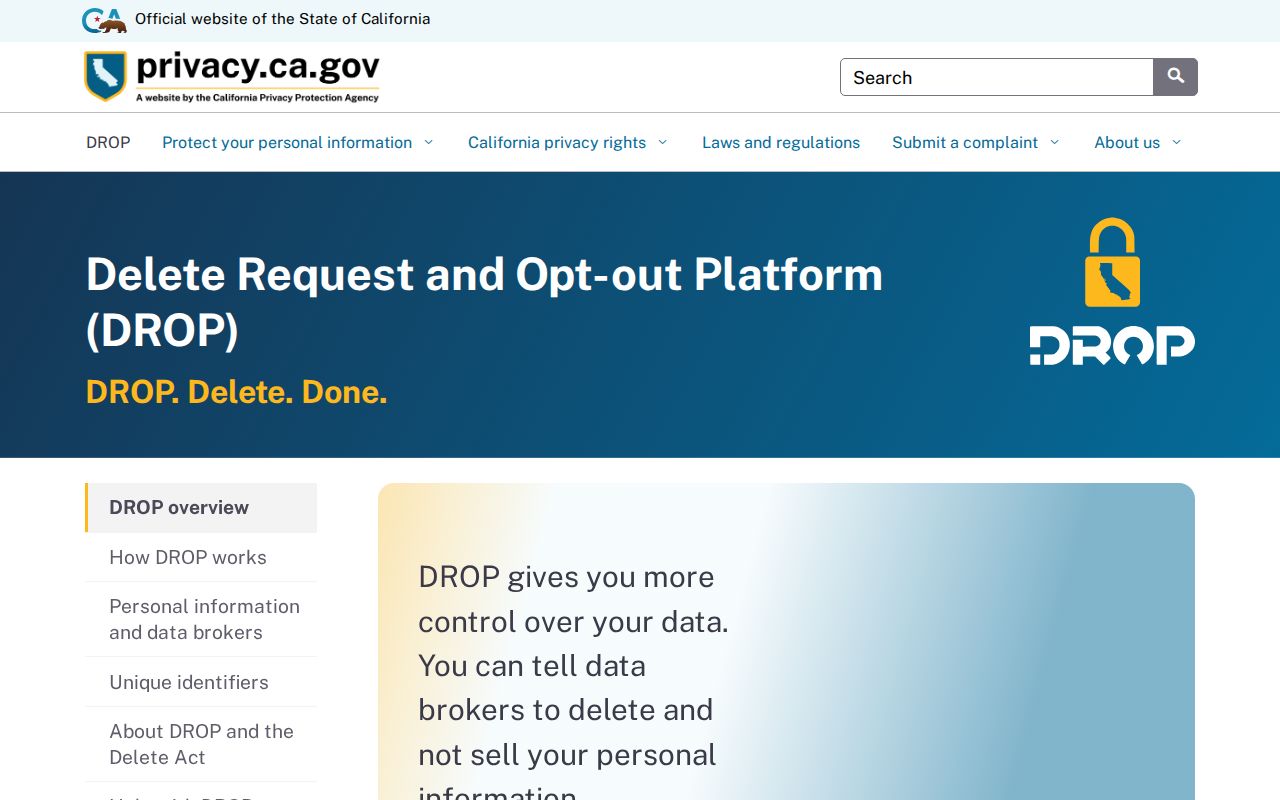
The state privacy page explains why removal is a separate task from records research. Use the official California DROP service for broker requests. Contact the actual office when an official record contains an error or protected information. Safe at Home and voter confidentiality rules may shield some addresses before a search begins.
Public-record access and personal safety can coexist. It happens when the source, purpose, date, and lawful boundary stay clear. That is the standard for a useful Vista residents directory. Find the right custodian. Read what the record means. Stop where the law stops.
Note: DROP reaches registered brokers, but only the official custodian can correct or release a government record.