
Sources for Vista Previous Residents
The best starting source depends on the era. Modern deeds and parcel facts establish the land. Historic deed books and specialized title series extend the chain. Directories and telephone books add listed occupants or subscribers. Census schedules give household structure at an enumeration date. Newspapers, probate, death records, and permits explain moves, estates, and changes to a structure.
| Source | Years it covers | Where held | What it shows |
|---|---|---|---|
| Recorder web index | 1970-present | San Diego County ARCC | Party, document type, recording date, number; no web image |
| County Archives deeds | 1846-1918 verified | County Archives, Santee | Conveyances, legal descriptions, signatures, prior references |
| Specialized title series | Homesteads 1860-1931; Torrens 1919-1955; other runs vary | County Archives | Alternative ownership and claim history |
| Regional directories | 1886-1984 holdings described; exact Vista coverage varies | California Room, History Center, Vista Library | Occupant, subscriber, occupation, address when listed |
| Vista Press | 1926-1973 | Vista Historical Society online archive | Obituaries, society, property, legal, and business clues |
| Federal census | Public through 1950 | NARA, libraries, partner databases | Household, relationship, occupation, birthplace, tenure |
| Permits and planning files | Local file years not published | Vista City Clerk and Development Services | Work, applicant, contractor, owner field at filing date |
The County Archives screenshot shows the historic fallback in practical terms. The archive is at 10144 Mission Gorge Road in Santee, with archives@sdcounty.ca.gov and 619-237-0502 listed for contact.
The San Diego County Archives access information gives the reading-room and contact route for older deed series.
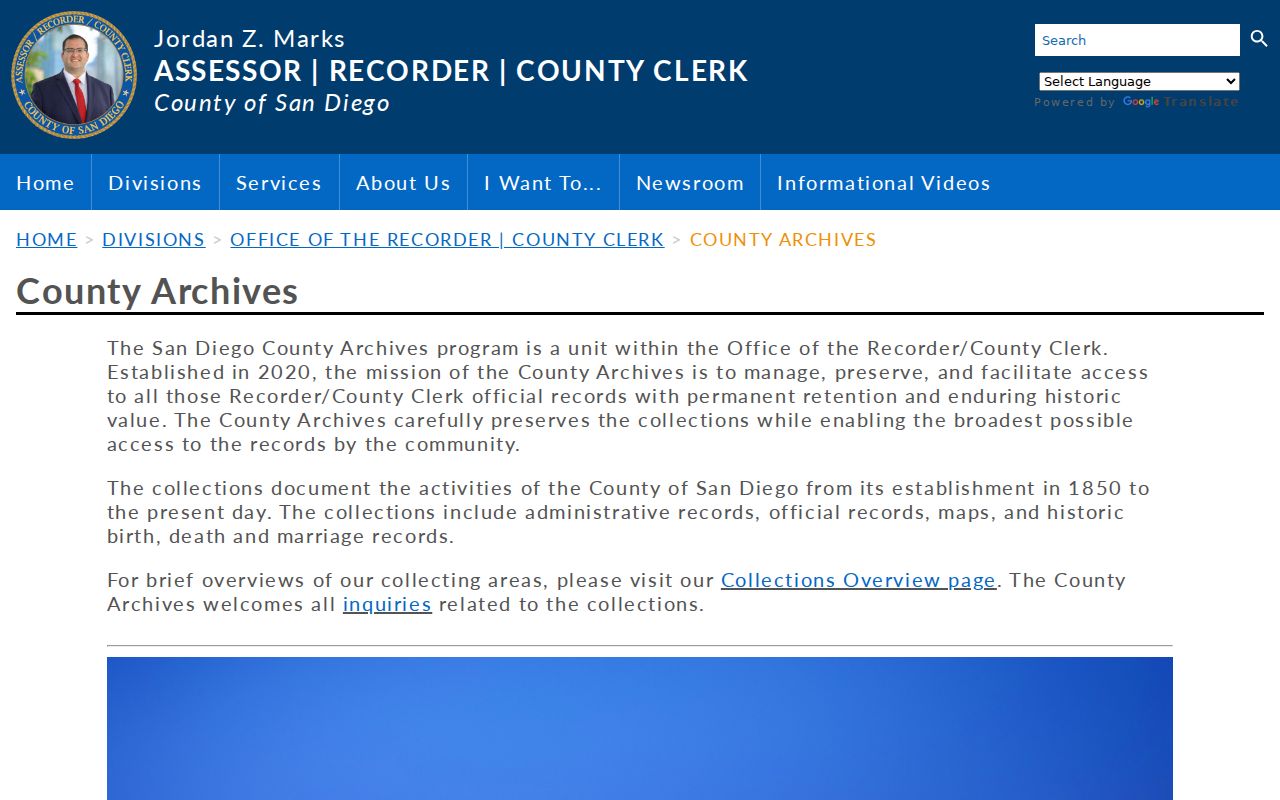
Archive staff need a series, date range, name, book or page clue, and county context. An archive catalog may not provide a personal-name index.
Note: Archive series coverage does not guarantee a personal-name index or complete Vista address coverage.
Vista Previous-Resident Parcel
Use the City of Vista map or a city map product to validate the situs address and parcel shape. The public city layer exposes the site address but not the owner. San Diego County's assessment roll can search an address, street name, or APN and return assessment facts, while the web result suppresses owner names. ARCC ownership and recorder channels supply the next step.
Keep the current vesting name, acquisition date, APN, subdivision, lot, block, and legal description together. A mailing address can differ from the situs. A trust or entity can hold title. The current owner is a starting node in a previous residents search, not the first person who ever lived at the property.
- Chain of title
- The sequence of recorded transfers and interests that connects present title to earlier parties.
- Vesting deed
- The instrument that placed the current interest in the present owner or entity.
- Legal description
- Subdivision, lot, block, or metes-and-bounds text that identifies the land more reliably than a street label.
- APN
- The county parcel number used for assessment and map work. It is not a person identifier.
Trace Vista Deed Records Backward
The recorder method is a repeated grantor and grantee search. Find the current acquisition deed, record its grantor, recording date, document number, legal description, and references. Search the seller as a grantee in an earlier period. Open the next deed and repeat. The result is a title chronology, not a list of every former household. A deed party may be an estate, trust, lender, company, or representative.
- Anchor the property. Confirm the APN, situs, subdivision, lot or block, and present vesting name through lawful ARCC channels.
- Find the acquisition instrument. Search the current name as grantee near the acquisition date and note document number, type, date, and legal description.
- Move to the seller. Search the grantor as a grantee in an earlier period, testing spelling and entity forms.
- Cross-check each join. Compare the legal description, not only the street address or a common surname.
- Leave the online range. Carry names, dates, book and page clues, and series terms to the kiosk or County Archives when the index ends.
The ARCC recording page documents the online index, copy order, and kiosk routes. Copies can be ordered after creating an account, and images can be viewed at public kiosks. The 2025 schedule lists two dollars for the first page, five cents for each additional page, and one dollar for certification.
Note: Legal descriptions resolve many false joins created by common names or changed street labels.
Vista Recorder Records Before 1970
The web index's 1970-present coverage is an online boundary, not a county-records boundary. At the cutoff, preserve the last indexed party, approximate date, document type, subdivision, lot, block, book, page, and any prior-document reference. ARCC staff or a county kiosk may identify a route that the public web form cannot.
APN searching changed on December 9, 2024, when ARCC removed it from the online Official Records Search under Assembly Bill 1785. Kiosk APN searching continues at five county offices. For a Vista property, an assessment or map search can supply the APN, after which an in-person kiosk becomes the more capable channel.
The county says an online copy order is printed the next business day and ordinary mail takes another three to five business days. The index exposes placement fields, not the full deed image, so a prior residents conclusion should cite the copy or kiosk view that supplied the legal description.
Note: The recorder's online cutoff should trigger a kiosk, archive, or staff request rather than a dead end.
Vista County Archive Deed Records
The County Archives documents deed holdings from 1846 through 1918. Specialized series add homesteads from 1860-1931, Torrens material from 1919-1955, patents and title registers from 1850-1930, and leases from 1869-1934. The series can fill gaps or add a land story that a standard grantor-grantee search misses. Coverage does not mean every book has a personal-name index.
Ask the archive by record series and land clue. Give the names as they appear in the last known deed, approximate years, subdivision or rancho, lot or block, and the current APN if one exists. County jurisdiction changed over time, and early Vista references may use Rancho Guajome, Rancho Buena Vista, Mission San Luis Rey, or a broader North County place.
Deeds establish transfers and legal land descriptions. They do not prove that a grantee occupied the property. The History Center public-records guide adds an archival example of land and tax-sale research. Use directories, census schedules, newspapers, probate, and permits for the people layer.
1930 Directory Evidence for Vista Addresses
The confirmed 1930 San Diego City and County Directory explicitly names Vista on its title page. That is a strong starting point for previous residents because the volume's town and post-office coverage explains why a searcher may not find a separate Vista book. The directory can show a name, occupation, and address or business relation for the publication year, depending on the section.
Regional holdings described by the San Diego Public Library California Room run from 1886 through 1984, with telephone directories from 1906 onward. The exact Vista-only publisher and reverse-directory years were not stated on the public pages. Ask the Vista branch, California Room, and History Center to confirm a volume before relying on its geographic scope.
The Vista city directory collections page explains how to read the historical shelf. For a past resident search, use the collection as a dated household clue and keep the edition, page, and abbreviation key with the deed chronology.
Vista Previous Residents in the Press
Annual issues of the Vista Press from 1926 through 1973 can bridge years when a directory or deed is silent. Search society columns for family links, advertisements for proprietors and addresses, legal notices for estates and property, school items, and obituaries for relatives and former places. OCR can miss names, so browse pages and test spelling variants.
A newspaper date is essential. An advertisement places a business at a time. An obituary may report a death, relatives, and former residence. A legal notice may identify a tax or estate event. None substitutes for the certified vital record, court file, or recorded instrument when the legal fact matters.
The Vista Historical Society archive is the online channel. The CSUSM research-resources gateway also points toward North County repositories and special collections.
The CSUSM research resources for North County collections identify repositories that may hold the next dated source.
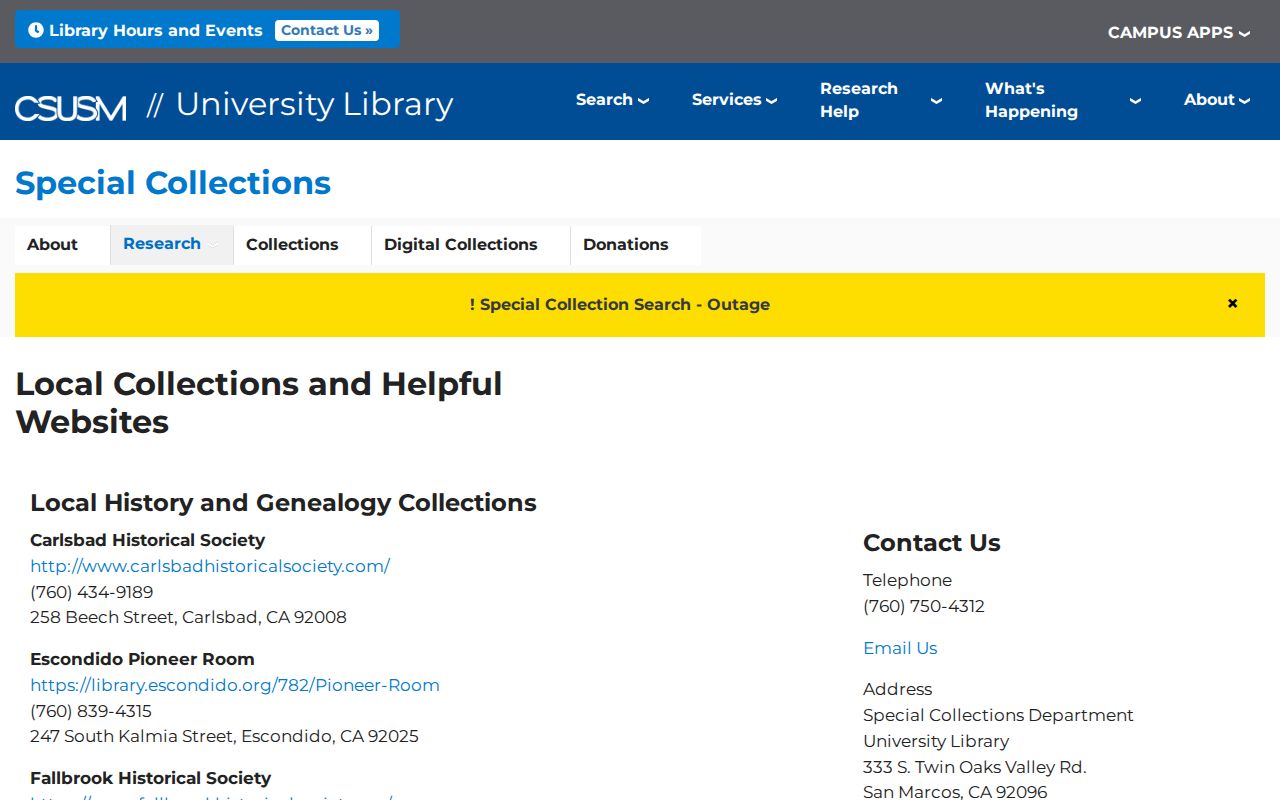
The archive gateway is a route map rather than a person index. Use it to identify which repository may hold the next dated source.
Past Vista Residents in Directories and Census
Household reconstruction works when the sources are paired by era. A directory may show a head, spouse, occupation, and address. The nearest public census through 1950 can add age, relationship, birthplace, and tenure at an enumeration date. An obituary can explain a death or family connection. A probate or deed can test the property event. None should be stretched beyond its own coverage.
- Find the first and last directory entries that fit the street and town geography.
- Pair each directory decade with the closest census and compare names, ages, relationships, and occupation.
- Use the Vista Press for the years between those snapshots, keeping page and publication date.
- Check probate, death, cemetery, or vital-record routes when a household ends or an heir appears.
A directory disappearance may mean a move, omission, death, boundary change, or publication gap. A census place name may not match modern incorporated Vista. The current parcel and legal description keep the address trail anchored while the household sources supply the people context.
Note: A directory entry, census household, and obituary each describe a dated slice of the same trail.
House-history rule. A past resident conclusion needs a dated source and a matching address or relationship clue. One directory line alone is not enough.
Vista Permit and Probate Records
Vista permit files can date physical change. An application may list a project address, APN, owner or applicant, contractor, permit type, issue date, inspection, and final status. The city says residential blueprints are not retained, so request permit history, inspection, final, and planning files. A permit date is a construction clue, not an occupancy date.
Probate can explain a transfer to an estate, surviving spouse, trust, or heir. San Diego probate indexes and the courthouse supply the case route, while California State Archives material documents San Diego probate from 1886-1918 and wills from 1880-1920. Death certificates and obituaries can close a household trail, but eligibility controls certified-copy access.
When the web is silent, make a narrow California Public Records Act request to the City Clerk or ask the archive or library for a named series. The ordinary determination window is ten calendar days, with a possible written fourteen-day extension. Record a negative finding as “not located in this source,” not as proof that the person or file never existed.
Vista Address History and Jurisdiction
Vista's municipal history affects every previous residents search. The post office name dates to 1882, the town layout to 1886, and incorporation to 1963. A postal Vista label before incorporation belongs to county or town records. A current address near a city edge may also carry a different postal city or older county planning file.
The Mar Vista planning trail records a 2024-25 transition for 108 parcels and roughly 143 acres formerly under county A70 zoning. Older permits or zoning records may remain county-held while later records are city-held. The research did not verify a dated Vista street-renumbering event or a complete Vista Sanborn map run, so do not invent a changed street name or map year. Preserve the legal description and ask a librarian or planning office to verify local history.
Lawful use. Previous residents research belongs in family history, property history, archival work, and lawful records review. Do not use an address trail to stalk, harass, threaten, or harm anyone.