
The Vista City Directory Shelf
The documented collection picture is a shelf of regional runs, one confirmed Vista-bearing volume, and local-history material whose exact years require a librarian's check. The table is deliberately precise about the difference between a confirmed coverage statement and a collection that still needs an entry-by-entry inspection.
| Collection | Verified years | Where held | Access and use |
|---|---|---|---|
| San Diego City and County Directory | 1930, Vista named on title page | City of San Diego scan and NARA list | Digital access; inspect the Vista town section and key |
| Information Relative to the City of San Diego | 1874 | San Diego History Center | Selected material online; hard copy and regional context |
| San Diego City and County Directory | 1886-87 | History Center documentation and repository catalogs | Check geographic coverage entry by entry |
| San Diego city and county directories | 1886-1984 | San Diego Public Library California Room holdings description | Onsite or reference inquiry; suburban coverage varies |
| San Diego telephone directories | 1906 onward in holdings description | California Room | Subscriber evidence; voluntary and incomplete |
| Vista and North County local history | Exact run not published | San Diego County Library, Vista branch | In-branch reference and shelf check |
The Vista branch image shows the library as the first practical stop for local history. Ask staff to search by publisher, regional title, telephone directory, reverse directory, yearbook, newspaper, and vertical file. A catalog label may hide a Vista entry under San Diego County.
The San Diego County Library's Vista branch page gives the current branch and catalog route for local-history research.
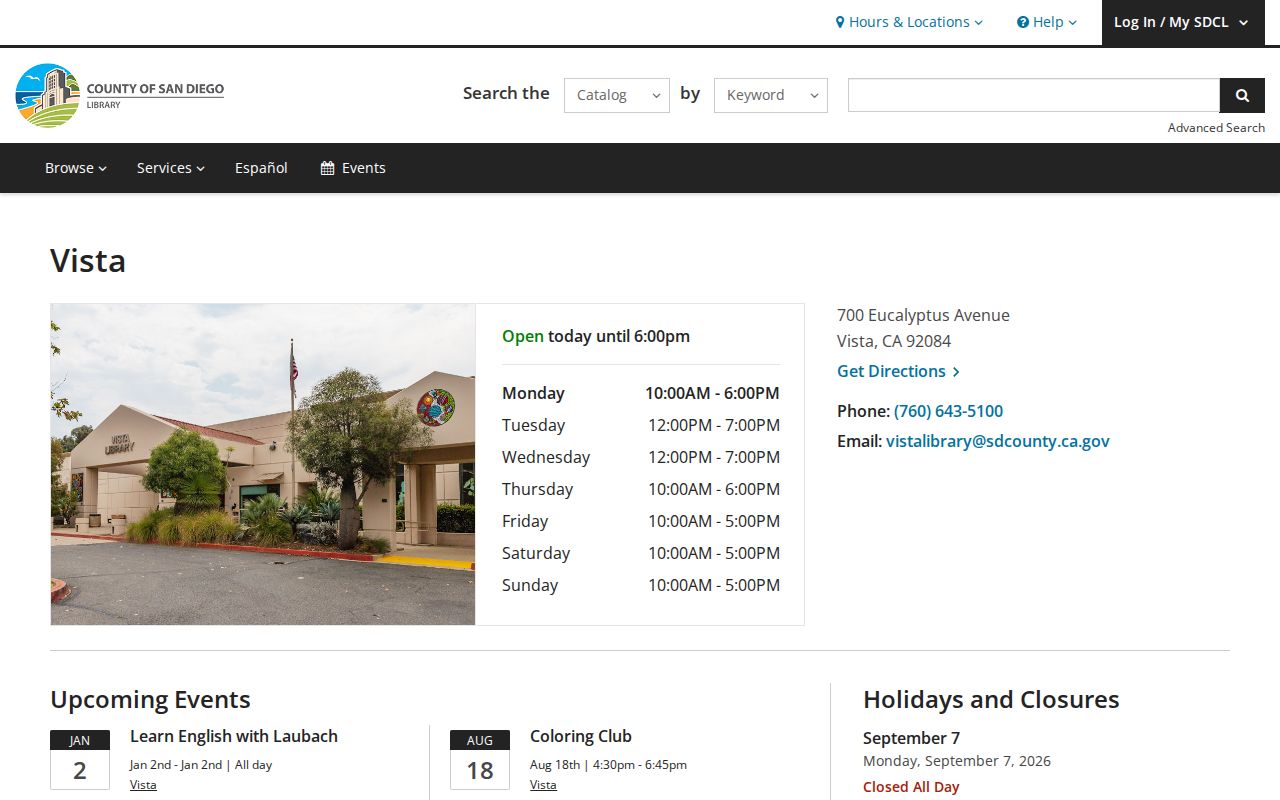
Library licenses and in-branch reference collections change, so confirm current database access and shelf availability before planning a long research session.
Note: A regional directory title must be checked for Vista coverage before a surname search begins.
A 1930 Vista Listing in a County Directory
The strongest verified Vista-bearing city directory is San Diego City and County Directory 1930 from San Diego Directory Company. Its title page explicitly lists Vista among covered towns and post offices, and the National Archives directory list independently identifies the San Diego volume as covering Vista. That title-page evidence matters because Vista had not incorporated yet. A regional book can carry the town even when a searcher expects a separate city volume.
Use the City-hosted 1930 directory scan to confirm the book's scope before searching names. Record the page, section, spelling, occupation, street, and any abbreviation. A town or post-office label does not guarantee that every surrounding rural address was included, so check the geographic headings around the entry.
The 1930 book is a useful bridge between the first Vista post office in 1882, the town layout of 1886, and later municipal records. It can show that a person or business was associated with Vista at a particular publication date. It cannot by itself prove a current home, ownership, or uninterrupted residence.
Vista City Directory History: 1874 to 1886-87
The earliest documented regional directory is the San Diego History Center's 1874 business book. The History Center's directory-history account says a San Diego City and County Directory followed in 1886-87 and notes that suburban areas had their own directory by the mid-twentieth century. Those facts create a chronology, not a promise of a Vista household roll for each year.
The 1874 selection is classified by business. Category headings such as newspapers, banks, hotels, and general merchandise group institutions and officials. A visible entry may include a company, corner or street, president, cashier, proprietor, manager, directors, correspondent, price, or service. That structure is closer to a commercial and civic directory than a household alphabet.
Use the digitized 1874 directory material as regional context. Search the business, institution, or person named, then ask whether the item proves an occupational connection or a home address. A hotel proprietor and a bank cashier are not automatically residents at the business location.
Note: A business-classified entry can place a person at work without proving a home address.
Reading a Vista City Directory Entry
A later city directory may have an alphabetical household section, a street or criss-cross section, an occupation list, and an abbreviation key. The actual Vista coverage and symbols must be checked in the edition being used. Treat the entry as a compact dated record and copy its punctuation, initials, street form, and marks before translating it.
| Entry field | What it may mean |
|---|---|
| Name | Head of household, subscriber, business principal, or a separately listed adult. |
| Occupation | Work or trade listed for that edition, sometimes with an employer. |
| Residence | House number and street when the volume uses a household format. |
| Spouse or widow mark | A family clue such as a spouse in parentheses or a widow notation. |
| Owner or renter symbol | A publisher's mark that must be read through that volume's key. |
- Criss-cross section
- The address-order portion of a directory. It can connect a street address to a listed name.
- Householder index
- An index organized around the head of a household or principal subscriber.
- Abbreviation key
- The publisher's explanation of occupation, residence, ownership, and relationship marks. Photograph or transcribe it first.
The 1874 sample shows why context matters. A bank entry can include its corner, officers, and correspondents. A hotel entry can include a street or corner, rate, and proprietor. The form of the entry tells you what the book was built to record.
Note: Photograph the abbreviation key before translating owner, residence, or relationship marks in that edition.
Vista Directories Between Press Years
The Vista Press archive supplies a hyperlocal bridge from 1926 through 1973. Annual groupings can connect a directory entry to society columns, visitors, family links, advertisements, legal notices, property news, school items, and obituaries. OCR may miss surnames, especially when a scan is faint or a name has several spellings, so browse the page when a keyword search fails.
Advertisements can put a proprietor or service at a dated address. A legal notice can name an estate or property event. An obituary can link relatives and a former address. None of those items should be treated as a certified vital record or title record. Preserve the publication date, page, and wording, then compare it with the county or state custodian when the event matters.
The Vista Historical Society archive is an online route. Its research value is greatest in the gaps between directory editions, when a household moved, a business changed hands, or an address appeared under a community label rather than a modern city name.
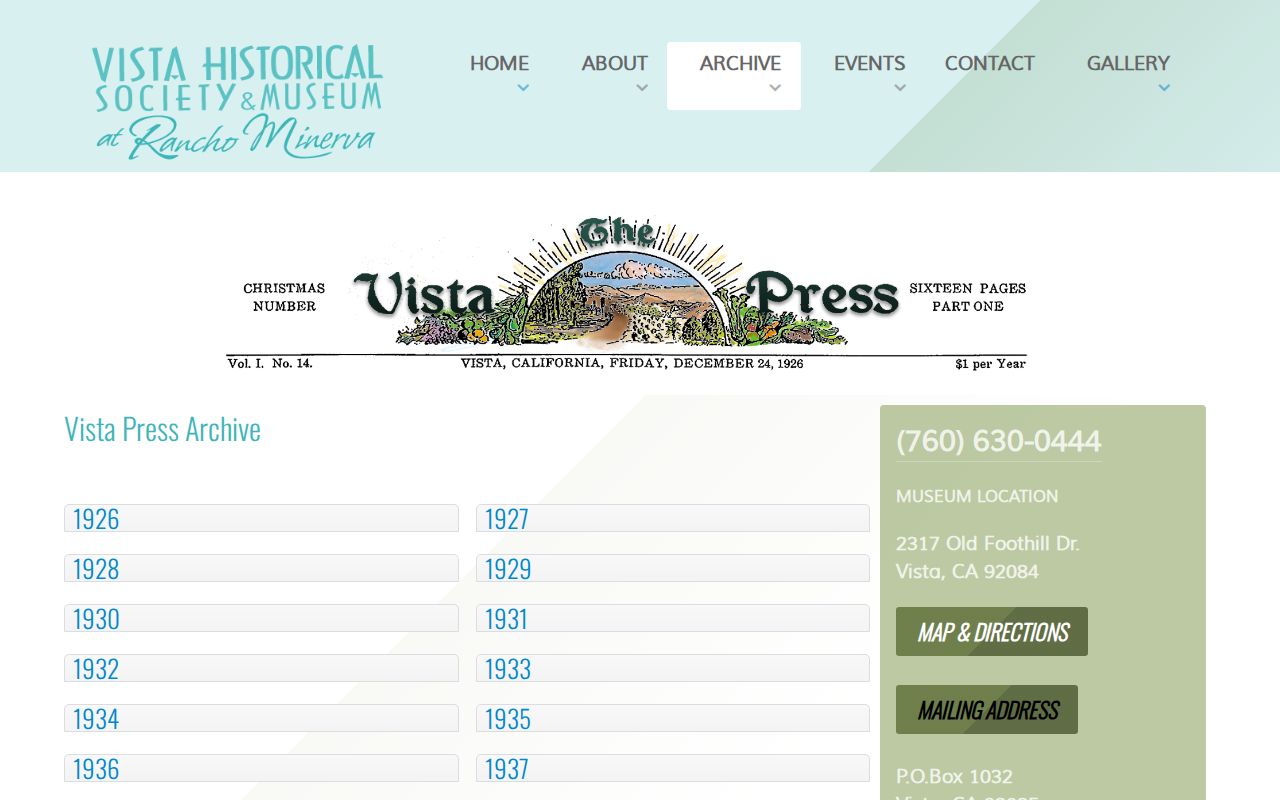
The archive capture shows a dated run rather than a universal resident list. Use its annual structure to choose the year before opening individual pages.
Tracing a Vista City Directory Household
Directory research works best as a sequence of dated snapshots. Start with a known address or person, then look for the first appearance, the next edition, and the last appearance. Compare street spelling, occupation, spouse marks, owner or renter symbols, and separate adult listings. A disappearance is a clue, not proof of a move or death.
- Set the geography. Confirm whether the address was inside Vista, a nearby town, or a rural postal area at the date of the volume.
- Read the title page. Record publisher, year, towns covered, and the location of the alphabetical, street, and occupation sections.
- Copy the entry. Preserve initials, abbreviations, street form, and page number before interpreting any symbol.
- Compare the next edition. Note a new spouse, occupation, address, widow mark, or separate adult without assuming the cause.
- Pair the clue. Use the nearest public census, deed, probate, obituary, yearbook, or permit to test the timeline.
Federal population census schedules are public through 1950 under the 72-year access rule. Enumeration geography and place names do not match modern Vista automatically. A directory entry and a census household can be paired only after the street, age, relationship, occupation, and county context agree.
Note: Directory disappearance is a clue that needs a second dated source, not proof of a move or death.
Where Vista Directory Research Happens
Start at SDCL for local-history reference, catalog help, licensed genealogy databases, newspapers, yearbooks, and vertical files. The Vista branch is documented as a large-reference location, generally for in-branch use. The SDCL collection policy helps explain why a shelf check may be necessary. Confirm whether a desired license or database is available on the research date rather than assuming a named commercial genealogy product remains active.
The San Diego History Center has virtual collections and archival descriptions, but its current research notice says in-person library and research resources are unavailable until further notice. Contact it through the documented email or phone route before traveling. CSUSM Special Collections maintains a research-resources gateway that points to North County repositories. The Vista FamilySearch Center at 1310 N. Foothill Drive advertises public computers, microfilms, scanners, printers, local books and records, and language help; recheck posted hours.
County Archives and the California State Archives are the government fallbacks for older deeds, probate, wills, naturalization, Great Registers, court, and assessor or recorder series. An archive catalog may not have a personal-name index. Ask by record series, county, date range, book or case number, and the name clue already found in a directory.
Why Vista City Directories Use County Books
San Diego County was created in 1850, while Vista's post office name was established in 1882 and the town was laid out in 1886. The city did not incorporate until January 28, 1963. The Vista official history provides the local chronology behind that sequence. A pre-1963 city directory search can fail when the correct book is titled San Diego City and County Directory or uses a town or post-office section.
Earlier land and community records may use Rancho Guajome, Rancho Buena Vista, Mission San Luis Rey, North County, or another local description. Water history also shaped the record trail. Vista Irrigation District financing in 1923 supported growth, and agricultural terms such as avocado, tomato, celery, orchard, packing, and irrigation can help find people in newspapers or business directories.
| Year or period | Records implication for Vista directory research |
|---|---|
| 1798 | Mission San Luis Rey was founded; early records use mission and rancho context. |
| 1845 | Rancho Guajome and Rancho Buena Vista grants precede municipal records. |
| 1882 | John Frazier secured the Vista post-office name. |
| 1886 | Vista Land Company laid out the town. |
| 1923 | Vista Irrigation District funding and Lake Henshaw water supported growth. |
| 1963 | Vista incorporated, beginning the modern city-record period. |
A county title page is therefore a research instrument. It tells you whether Vista is in scope before a name search begins. The Census QuickFacts profile for Vista supplies current civic context, but it is not a resident roll. The page also helps distinguish a regional business directory from a household directory and a postal place from an incorporated municipality.
Pair Vista City Directory Clues With Records
An old entry becomes more useful when a modern source tests only the part it can answer. A current map can locate the street and parcel. ARCC can establish a recorded instrument and legal description. A court or probate index can identify a case role. A vital certificate can confirm an event when eligibility allows. The Vista resident lookup workflow is the right next step when a directory find needs identity verification, while Vista street records own the modern address chain.
Do not force an exact Vista-only directory run where the research has not verified one. The public sources explicitly leave the publisher and year range for a complete local suburban run as a shelf-check gap. Honest uncertainty is part of the record. Write “not located in this edition or index” rather than “no resident existed.”
Research note. The 1930 county volume is confirmed for Vista. Exact Vista-only Polk, Haines, suburban, and reverse-directory years remain a librarian verification task.